



Finding Balance Between Guiding and Letting Go

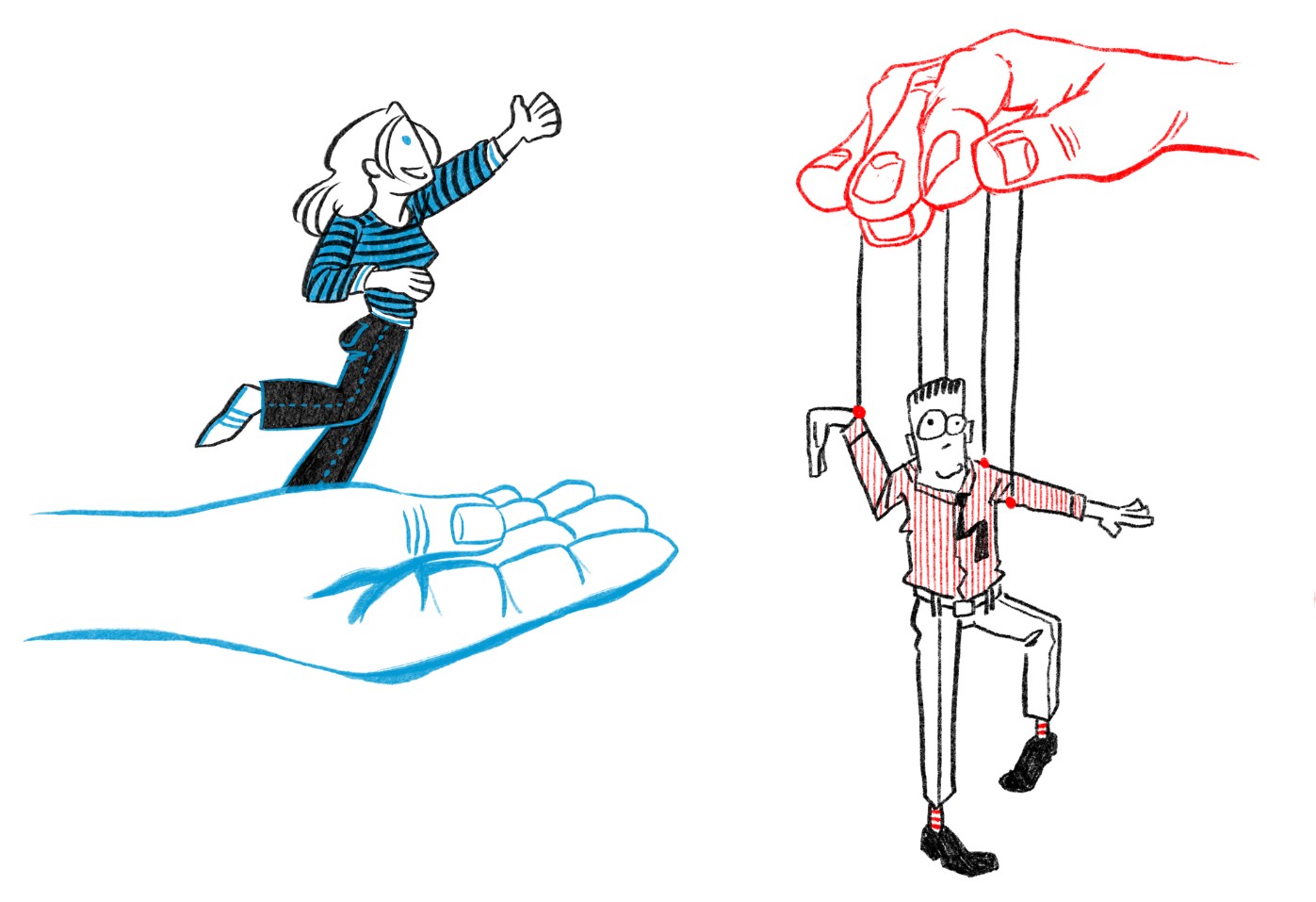
‘Trust is good, control is better.’
It sounds reassuring. Certainly. Manageable.
But in practice, it is often the start of the problem.
Because the more you control, the less people think for themselves.
The less they think for themselves, the less ownership they take.
And before you know it, as a leader, you have exactly what you were trying to avoid:
a team that waits. Hesitates. And becomes dependent.
If you truly want shared leadership, you must dare to do something different:
give space. And above all: give trust.
Shared leadership doesn’t start with letting go, but with building
Many leaders think that letting go is a decision.
“I’m going to give my team more autonomy.”
But that’s not how it works.
Letting go without a foundation is not leadership — it’s chaos.
As a leader, you first build the context in which people can make decisions.
Only then you can give them space.
That context consists of a number of crucial building blocks:
- A clear shared purpose
Do people know what they’re working towards? And why it matters?
- Clear expectations
What does ‘good work’ actually mean? When is something successful?
- Clear roles and responsibilities
Who decides what? And where does ownership lie?
- Supportive processes
Think of consultation structures, visual management, data-driven monitoring.
Not to control, but to provide direction.
- The right knowledge and skills
Can people make effective decisions? Do they have the tools?
Trust is not a feeling. It is a choice — and a risk.
This is often where the problem lies.
Leaders say: “I trust my team.”
Until something goes wrong.
Then they revert to control.
True trust means: accepting that people make different choices than you would.
And that sometimes mistakes are made.
But that is precisely where growth happens.
When people feel they are given space and that mistakes are not immediately punished,
something fundamental happens:
- they take the initiative
- they think ahead
- they feel a sense of ownership over their work.
And perhaps even more importantly:
they begin to see their work as meaningful.
Letting go doesn’t happen overnight. You build it up.
A common mistake: waiting until everything is ‘ready’ to let go.
Until the process is perfect.
Until everyone is fully trained.
Until all risks are covered.
That moment will never come.
You build shared leadership step by step:
- Start small: grant autonomy within a defined area
- Make it clear what does and does not fall within their scope of decision-making
- Discuss decisions together, not to correct but to learn
- Reflect on what works and what doesn’t.
This is how people learn to handle autonomy. And you, as a leader, too.
Because let’s be honest: letting go is often harder for the leader than for the team.
The real balance
Balance between guiding and letting go is not a 50/50 story.
It is not a sliding scale that you set correctly once and for all.
It is a continuous interplay of:
- providing direction and allowing space
- creating clarity and showing trust
- intervening when necessary and consciously choosing not to intervene.
Strong leadership does not lie in maximum control.
Nor does it lie in maximum freedom.
It lies in the ability to sense what your team needs —
and to act on it.
Finally
If you find yourself constantly pulling and pushing your team, ask yourself this question:
Do they have too little autonomy?
Or do I have too little trust?
Because often the answer lies less with the team
and more with how we, as leaders, dare to give them space.
And that is where your team’s growth begins.
Contact us so we can work on solutions together.

Stanwick. Drive for results
Stanwick offers result-oriented coaching programmes on operational excellence, project excellence and supply chain excellence with a focus on people, organisations and processes. We perform thorough assessments, develop clear roadmaps and implement and anchor improvements to guarantee sustainable results.
Our Stanwick Academy organises extensive training courses in which you learn together with a like-minded community about project management, continuous improvement, data-driven organisations, leadership and change management.