



Why Finance & Opex Go Hand in Hand

We’ll dive straight into a client case study to illustrate this: a food company’s filling line had become around 6 per cent more efficient in the space of three months. The initial target was even exceeded. Yet this was not a successful improvement project. Operationally, the target had been met, but the expected business value ultimately failed to materialise.
The approach itself was, however, thorough. Based on data, the biggest losses were identified and two targeted improvement programmes were set up: one focusing on short stoppages and technical faults, and one on standard settings. Components were addressed, operators and technical staff received the necessary training, and lessons learnt from other factories with similar machinery were incorporated. For the settings, operators and managers were brought together to establish new standards.
However, the positive result did not lead to additional, saleable output. The bottleneck was not on the filling line, but earlier in the production process. Whilst the line was capable of processing more, it ultimately did not receive any additional product. Local OEE therefore improved, without the company as a whole being able to produce more.
This case illustrates why an operational improvement should never be assessed solely on the basis of the KPI selected for the project. It must always be translated into value for the entire organisation.
After all, what does the improvement actually deliver? Increased sales, lower costs, reduced stock, a deferred investment or lower risk?
A project objective must therefore not stop at ‘increasing OEE’. It must also specify the pathway through which that improvement will create value. Otherwise, there is a risk that different departments will each improve their own performance, whilst the profitability or financial strength of the company as a whole remains virtually unchanged.
From operational performance to financial value
This is where the finance department ultimately comes into the picture. Not as a control function that calculates retrospectively whether a project has ‘delivered’ sufficiently, but as an additional perspective to better understand in advance what value we are trying to create. Whereas Accounting mainly looks back and records what has happened after the event, Finance looks just ahead: how do we deploy the available funds and what future value do we expect to create with them?
This is precisely where Finance intersects with Operational Excellence. After all, an operational improvement can create value in various ways. Increased output at the bottleneck can generate extra turnover, reduced wastage lowers costs, and freed-up capacity can defer an investment.
But value does not only appear in the profit and loss account. The way in which a company uses its resources and how quickly invested money is converted back into cash is also important. How long do materials remain in stock? How quickly do customers pay? How efficiently are assets used to generate turnover? These, too, are questions about productivity, but viewed through a financial lens.
This brings us to the concept of ‘working capital’.
When cash is tied up in the process
A company usually spends money before it receives payment itself. It buys materials, keeps them in stock, processes and sells them, and then waits for payment from the customer. During that cycle, cash is tied up in day-to-day operations.
Working Capital = stock + trade receivables − trade payables
The period between paying suppliers and receiving payment from customers is known as the ‘funding gap’.
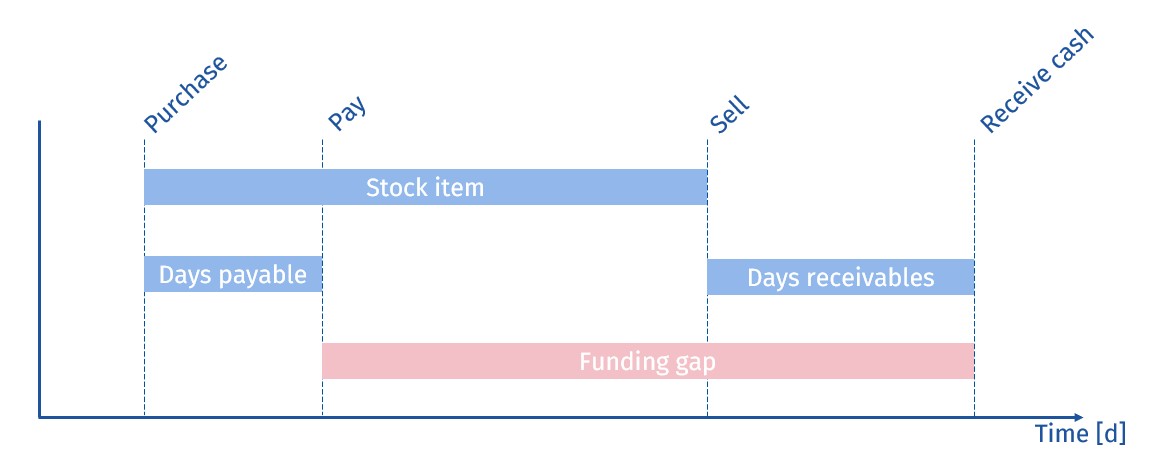
Funding Gap = days’ inventory + customer payment term – supplier payment term
The longer materials remain in the supply chain and the later customers pay, the more money the company itself has to pre-finance. As a result, even a profitable company with a strong product can run into difficulties if there is insufficient cash available.
Working capital makes the link between Operations and Finance particularly tangible. The finance department can see how much money is tied up in the process. Operations, Supply Chain, Sales and Procurement largely determine why this is the case — and where that cash can be freed up again.
Improving working capital is a team effort
At one of Stanwick’s other clients, a manufacturing company wanted to reduce its working capital by an amount equivalent to 6 per cent of its twelve-month turnover. This would free up cash for growth and investment without requiring an equivalent amount of additional financing.
The first area to be addressed was trade receivables. The follow-up of outstanding invoices was improved through technical adjustments to the software and better coordination between Sales and Finance. After all, late payments are not always the result of uncooperative customers. Incorrect invoices, unclear terms and conditions or poor follow-up can also cause cash to be received later than expected.
Next, trade payables were examined. For key suppliers, the possibility of extending payment terms was explored. This required negotiations with both suppliers and credit insurers.
The third lever was stock. Deliveries were better aligned with specific production runs. For certain semi-finished products, a ‘supermarket principle’ was introduced, whereby materials were replenished based on actual consumption. This ensured a steady supply whilst reducing the amount of stock required and lowering the risk of obsolescence.
What appears on the balance sheet as a single financial figure thus turned out to be the result of decisions taken within Sales, Procurement, Supply Chain, Operations, IT and Finance.
Finance highlighted where cash was tied up and which improvements could have the greatest financial impact. The operational and commercial departments then had to realise that value.
Business value as a shared goal
Finance and Operations therefore view the same company from different perspectives.
Operations sees machinery, material flows, lead times, disruptions and stock levels, whereas Finance sees costs, cash, returns and financing requirements.
Those who look solely at the financial figures see the result, but not the operational causes. Those who look solely at operational KPIs may see an improvement without knowing how much value it actually creates for the company.
The combination of both perspectives is therefore necessary to make better decisions.
This does not mean that every improvement project should be judged solely on the basis of financial gain. Safety, quality, compliance, staff and customer satisfaction can, in themselves, be sufficient reasons to take action.
However, when a project is intended to create value, it must be clear where that value arises and how it manifests itself: as profit, cash, additional capacity, an avoided investment or a reduced risk. When Operations and Finance share the same vision of business value, Operational Excellence makes a real impact.
Would you like support with your Operational Excellence programme? Please get in touch.
Find out more about our expertise in Operational Excellence.
Discover our Operational Excellence courses.
Discover recent OPEX case studies.
Contact us so we can work on solutions together.

Stanwick. Drive for results
Stanwick offers result-oriented coaching programmes on operational excellence, project excellence and supply chain excellence with a focus on people, organisations and processes. We perform thorough assessments, develop clear roadmaps and implement and anchor improvements to guarantee sustainable results.
Our Stanwick Academy organises extensive training courses in which you learn together with a like-minded community about project management, continuous improvement, data-driven organisations, leadership and change management.