

Why most warehouses never become best-in-class

During our warehouse assessments at Belgian and European manufacturing companies, retailers and logistics service providers, Stanwick consultants observe that virtually every warehouse manager strives for an efficient, reliable and future-proof operation. Yet only a limited number of warehouses achieve the standard of a best-in-class warehouse.
Remarkably, this is rarely down to a lack of technology, budget or motivated staff. The biggest challenge lies in something far more fundamental: the way in which an organisation continuously improves itself.
The problem is rarely the problem
When warehouse performance comes under pressure, the same symptoms are often cited: productivity is too low, there are too many picking errors, the warehouse is too full, staff seem to be constantly playing catch-up, and delivery reliability is under pressure.
But in our logistics consultancy projects, we see that these are not the real causes. The underlying challenges often run deeper:
- processes that are insufficiently standardised
- warehouse KPIs that are used incorrectly or insufficiently to guide operations
- unclear responsibilities and
- improvement initiatives that are not sufficiently embedded in day-to-day operations.
As a result, organisations continue to operate reactively. And reactive organisations rarely become best-in-class.
Moreover, the impact of these challenges is rarely confined to the warehouse itself. They often have a direct influence on stock availability, transport efficiency, customer service and, ultimately, the performance of the entire supply chain.
That is why, at Stanwick, we never view Warehouse Excellence as an isolated domain, but as an essential building block of Supply Chain Excellence.
No standard, no improvement
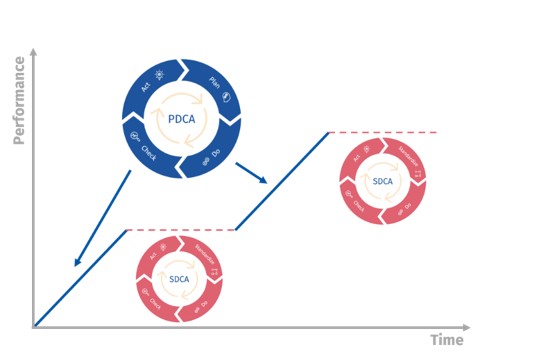
When every employee carries out a task in a slightly different way, improvement becomes virtually impossible. Without standardised work, there is no firm foundation on which improvements can be built. Standardisation does not mean that employees lose their flexibility. On the contrary: it ensures that improvements apply to everyone and that performance becomes predictable.
Knowledge lies with the people, not with the organisation
In many warehouses, experienced staff are indispensable. They know exactly where exceptions occur, which products or SKUs require extra attention, and how problems can be resolved quickly.
That knowledge is immensely valuable, but it also poses a risk. As soon as these staff members leave, a large part of the operational knowledge often disappears.
Best-in-class organisations ensure that knowledge is embedded in standards, training programmes and improvement processes. In this way, knowledge becomes the property of the organisation rather than that of a few individuals.
Day-to-day operations always take precedence
Orders must be processed, because customers won’t wait. Problems demand immediate attention. In many organisations, day-to-day operations absorb all attention, leaving little time to work on structural improvements.
This is often precisely where the difference lies between average and excellent organisations.
The latter do take the time to examine the root causes, improve processes and thereby structurally enhance logistics performance. This requires leadership, discipline and, above all, the conviction that continuous improvement is not a luxury, but an essential part of warehouse management.
Because without that investment, the same problems keep recurring and organisations continue to play catch-up.
Improving without direction
Another pitfall we regularly encounter at Stanwick in Supply Chain Excellence programmes is that warehouses are constantly improving, but not always with a clear direction. There are projects underway relating to layout, scanning, warehouse KPIs, stock management, training or WMS optimisation.
These are all valuable initiatives in their own right, but they often lack coherence.
Exactly which problems are we trying to solve?
Which priorities have the greatest impact on warehouse performance?
What impact do we expect?
And how does an initiative contribute to the organisation’s maturity?
Without this common thread, there is a risk that a great deal of energy is invested in improvements, whilst the underlying bottlenecks remain unaddressed. For this reason, during our warehouse assessments, we not only analyse individual improvement projects but also evaluate the underlying foundations of a warehouse, such as organisation, processes, performance, data, systems, people and continuous improvement. Only in this way can an objective picture of the organisation’s maturity be formed, and an impactful roadmap towards Warehouse Excellence be developed.
Too much focus on technology
When performance falls short, attention often shifts quickly to technology. A new WMS, dashboards, automation or AI are expected to provide the solution. Although technology can be an important lever for Warehouse Excellence, it rarely solves fundamental problems.
Technology primarily amplifies what is already present: unclear processes or unreliable data simply become apparent more quickly.
In our logistics transformation projects, we begin by gaining a clear understanding of the warehouse’s current operations and maturity. We then ensure the fundamentals are in order before seeking to maximise the benefits of technology.
Conclusion
Many warehouses never become best-in-class because they try to move too quickly, when what they actually need is a stronger foundation. They invest in solutions without first understanding their maturity level. They expect a great deal from technology, whilst the greatest gains often lie in processes, collaboration, ownership and continuous improvement.
Best-in-class warehouses make a different choice.
They consciously build an organisation capable of sustainable performance, even as complexity, volumes or customer expectations increase. They realise that Warehouse Excellence is not achieved through a single major project, but by consistently working to develop the organisation’s maturity. It is the mindset and ambition to continually improve as an organisation in delivering reliable, efficient and scalable performance.
And that is precisely where the difference lies between a warehouse that merely functions and one that excels.
Curious to find out how mature your warehouse is today?
At Stanwick, we support organisations in Belgium and across Europe through warehouse assessments, logistics optimisation programmes and Supply Chain Excellence initiatives. In this way, we identify fundamental opportunities for improvement and work with you to build a roadmap towards sustainable Warehouse Excellence.
Book a consultation about your Warehouse Excellence program or learn about Lean Logistics through Stanwick Academy.
Contact us so we can work on solutions together.

Stanwick. Drive for results
Stanwick offers result-oriented coaching programmes on operational excellence, project excellence and supply chain excellence with a focus on people, organisations and processes. We perform thorough assessments, develop clear roadmaps and implement and anchor improvements to guarantee sustainable results.
Our Stanwick Academy organises extensive training courses in which you learn together with a like-minded community about project management, continuous improvement, data-driven organisations, leadership and change management.