



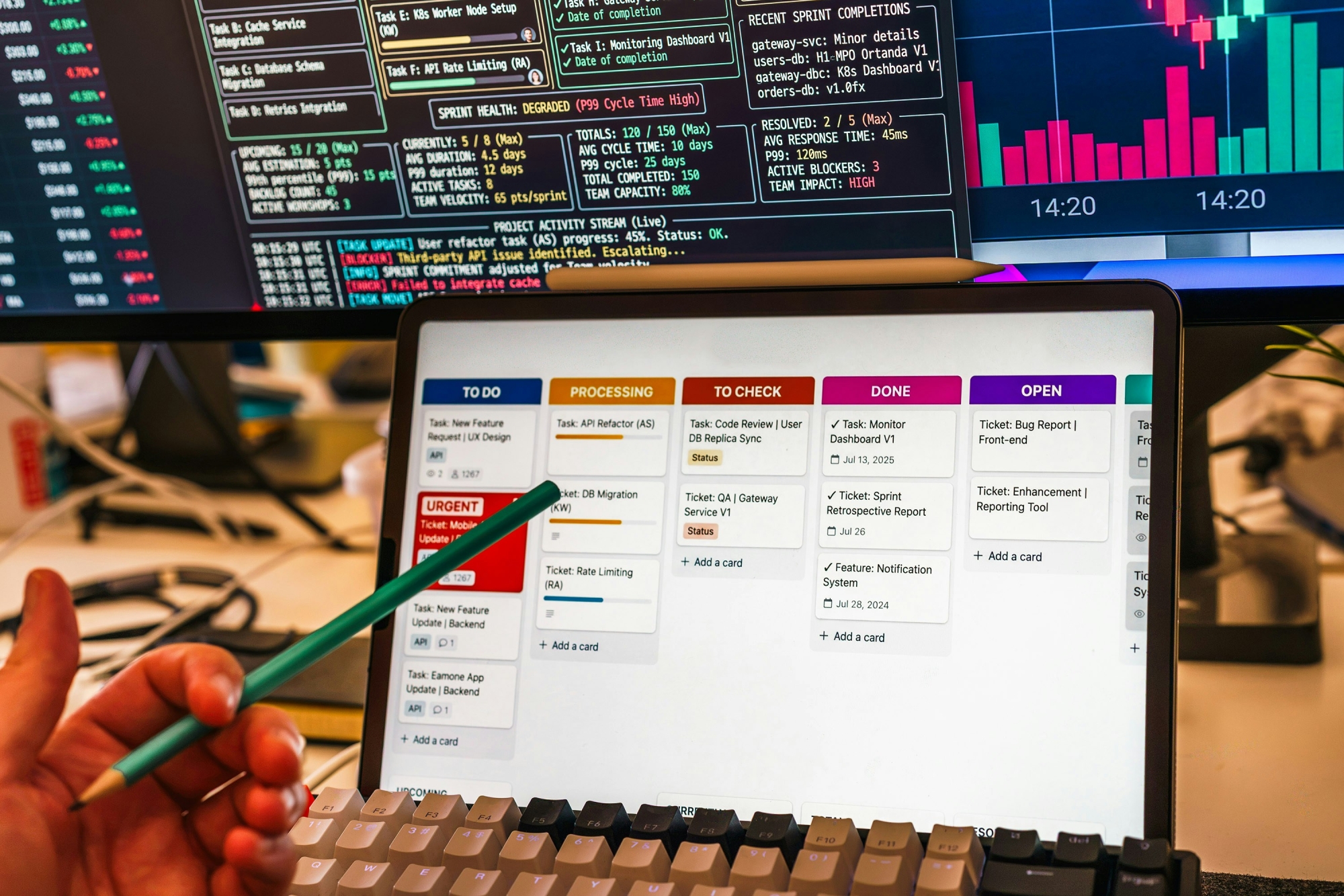

Digitalisation in Operations
 This is an in-company course
Target group
For supervisors, team leaders, improvement engineers and operational managers who:
- Want to use digitalisation as a lever for process improvement.
- Want to understand how technologies from the ‘digitalisation landscape’ – such as MES, AI, digital twins and AR/VR – work and create value.
- Are looking for practical tools to successfully implement digitalisation projects.
- Want to develop their skills in process thinking, technology integration and change management.
Our approach
- The course consists of two interactive training days.
- We combine theory with practical exercises, demonstrations and moments for reflection.
- You will work on a single central case study, which you will develop further throughout the course.
- You’ll learn to apply digital tools and systems to your own operational context.
- We guide you step by step through the process of drawing up a digitalisation roadmap.
- We focus on change management: how do you build support and foster a willingness to change?
- There is plenty of scope for dialogue, sharing ideas and learning from one another.
- You’ll leave with a concrete action plan that you can implement straight away within your team.
- Upon completion, you will receive a certificate of attendance.
What can you expect?
During this two-day training course, you will discover how digitalisation in operations can truly create added value. You will learn how to strategically deploy technologies from the ‘digitalisation landscape – Industry 4.0’, such as MES, AI, digital twins and AR/VR, to optimise processes, reduce errors and support staff.
Throughout the course, we’ll work on a single central practical case study. You’ll start with a Makigami exercise to map out and improve the process. You’ll then apply digital solutions to this case study step by step. In this way, you’ll experience how digitalisation begins with process insight and culminates in change that is embraced by the organisation. We’ll also focus on change management: how do you get people on board with the change?
After this training:
- You will understand how digitalisation connects processes, people and systems.
- You will be able to assess which digital tools are relevant to your operational context.
- You will have an understanding of the implementation of systems such as OEE, MES and visual management.
- You will have an overview of technologies within the ‘digitalisation landscape’ and their applications.
- You will know how to use digital twins and simulation models for process optimisation.
- Do you have an understanding of the human side of change: how to build support and engagement?
- Do you have a concrete plan to implement digitalisation step by step and with broad support?
Programme
Day 1 – Fundamentals of digitalisation in operations
- Introduction: what does digitalisation mean in an operational context?
- Launch of the central case study & explanation of the digitalisation roadmap/maturity model
- Makigami exercise – mapping and improving processes
- Visual management: dashboards, iObeya, ANDON screens, light towers
- Introduction to digital systems (OEE, MES and paperless working)
- Hands-on demos and application to the case study
- Reflection: where do our processes stand today?
Day 2 – Technology as a driver for sustainable improvement
- Overview of the ‘digitalisation landscape’
- Digital twins and simulation models: optimising processes virtually
- Integration between systems: from silos to flow
- Autonomation and robotisation: man and machine in harmony
- Mass customisation: flexibility in production
- Change management basics: how do you get people on board with digitalisation?
- Drawing up your own digitalisation roadmap
- Peer feedback & action plan
Trainers


Testimonials
Video
We are happy to help.
2 days
Hybride (face2face - remote)
Fundamentals
Deepen your knowledge


Bring knowledge to your company
Our training courses respond to the business context and specific working situation of the participants to the maximum extent. The knowledge, models and techniques introduced are immediately applicable in practice.