



Fundamentals of Sales & Operations Planning



What does Sales & Operations Planning mean?
Sales & Operations Planning (S&OP) is an integrated management process that aligns demand, supply, capacity, stock and financial objectives. The aim is to unite the Sales, Operations, Supply Chain and Finance departments, as well as senior management, around a single, widely supported business plan and a common set of facts.
According to APICS (American Production & Inventory Control Society), S&OP is:
“A process through which management develops tactical plans to strategically steer the business. The process integrates commercial plans with supply chain management and brings together, amongst other things, sales, marketing, development, manufacturing, sourcing and finance into a single integrated set of plans.” (Source: https://www.ascm.org/topics/sales-and-operations-planning)
At Stanwick, we take an even broader view. For us, S&OP is not just a planning process, but above all a supply chain decision-making process. It helps organisations make better decisions regarding customer demand, capacity, stock, service levels, risks, margins and working capital. S&OP thus forms the bridge between strategy and execution: it translates commercial ambitions and strategic objectives into achievable operational and financial decisions.
What steps are involved in an S&OP process?
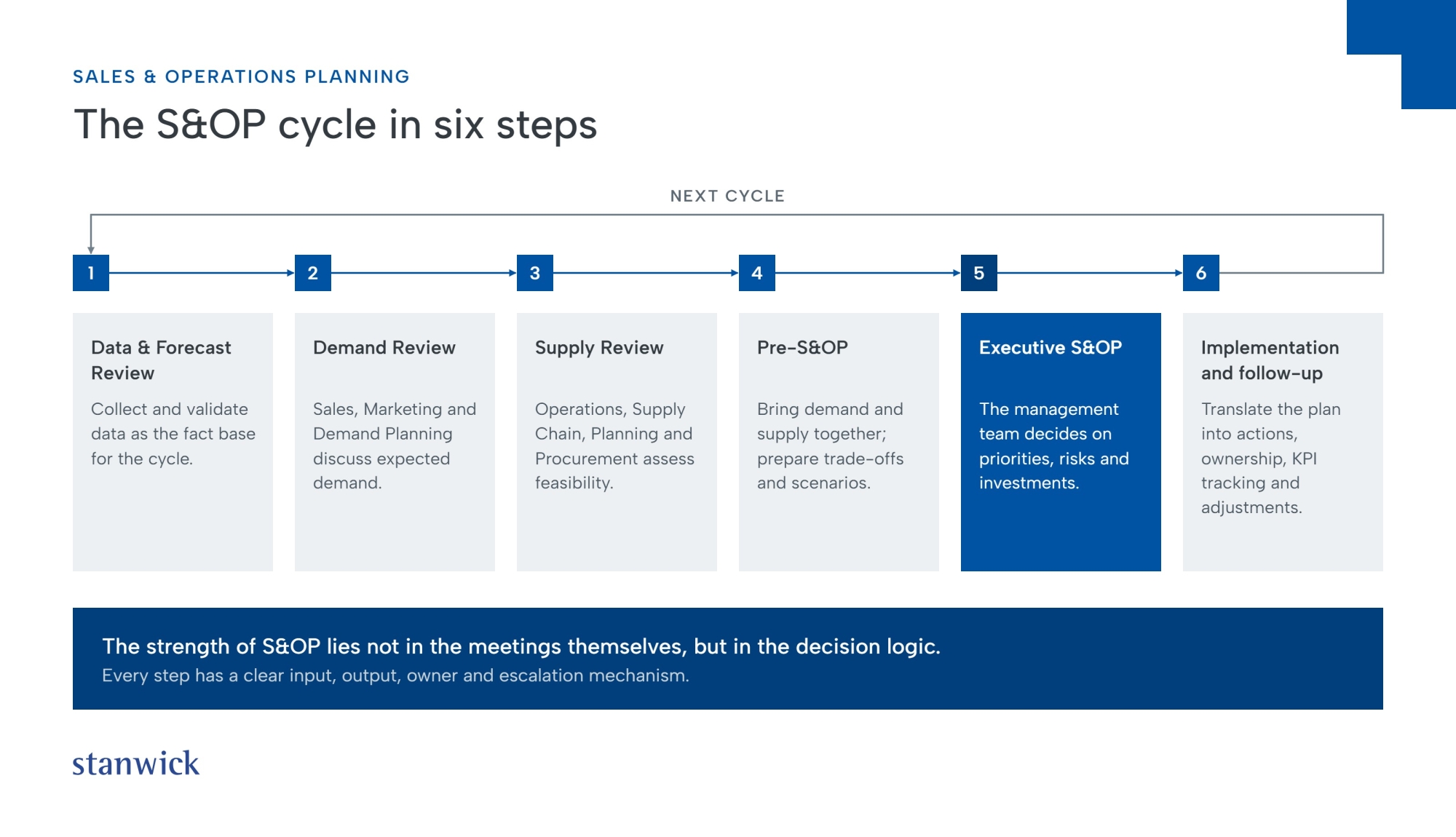
An S&OP cycle comprises six recurring steps, from data validation to management decision-making and follow-up. ASCM describes the S&OP cycle as including forecasting, demand planning, supply planning, pre-S&OP, executive S&OP and the finalisation or implementation of the approved plan.
In practice, a robust S&OP cycle often looks as follows:
1. Data & Forecast Review
The organisation collects and validates data on sales, forecasts, customer demand, stock, service, capacity and financial performance. This forms the factual basis for the rest of the cycle.
2. Demand Review
Sales, Marketing and Demand Planning discuss the expected demand. This involves a discussion of commercial initiatives, promotions, customer insights, market developments, forecast accuracy and forecast bias.
3. Supply Review
Operations, Supply Chain, Planning and Procurement assess whether the expected demand is achievable. Capacity, materials, suppliers, stock levels and bottlenecks are identified.
4. Pre-S&OP
Demand and supply are aligned. Trade-offs are prepared and scenarios are developed, for example, regarding service level, stock, capacity, turnover, margin and working capital.
5. Executive S&OP
The management team makes decisions on priorities, risks, investments, resources and financial impact. APICS emphasises that S&OP involves organising regular meetings with senior executives to resolve demand-versus-supply trade-offs and validate resources.
6. Implementation and follow-up
The approved plan is translated into actions, ownership, KPI monitoring and adjustments in the next cycle.
The strength of S&OP therefore lies not in the meetings themselves, but in the decision-making logic: every step has a clear input, output, owner and escalation mechanism.
Which departments are involved in S&OP?
A good S&OP process is, by definition, cross-functional. At the very least, Sales, Operations, Supply Chain, Finance and management must be involved. APICS identifies roles such as the executive champion, S&OP process owner, demand planning team, supply planning team, pre-S&OP team and executive S&OP team as key building blocks of a mature S&OP process.
Each function makes a specific contribution:
- Sales provides customer insights, commercial opportunities and market expectations.
- Demand Planning translates historical data and commercial input into a validated forecast.
- Supply Chain monitors stock levels, availability, suppliers and end-to-end flow.
- Operations assesses capacity, resources, planning and operational feasibility.
- Finance translates scenarios into their impact on turnover, margins, costs and working capital.
- Management makes decisions on priorities, trade-offs and risks.
A common mistake is to view S&OP as something ‘belonging to Supply Chain’. Supply Chain can facilitate the process, but S&OP only really works when the management team takes ownership of the key decisions.
What are the benefits of S&OP?
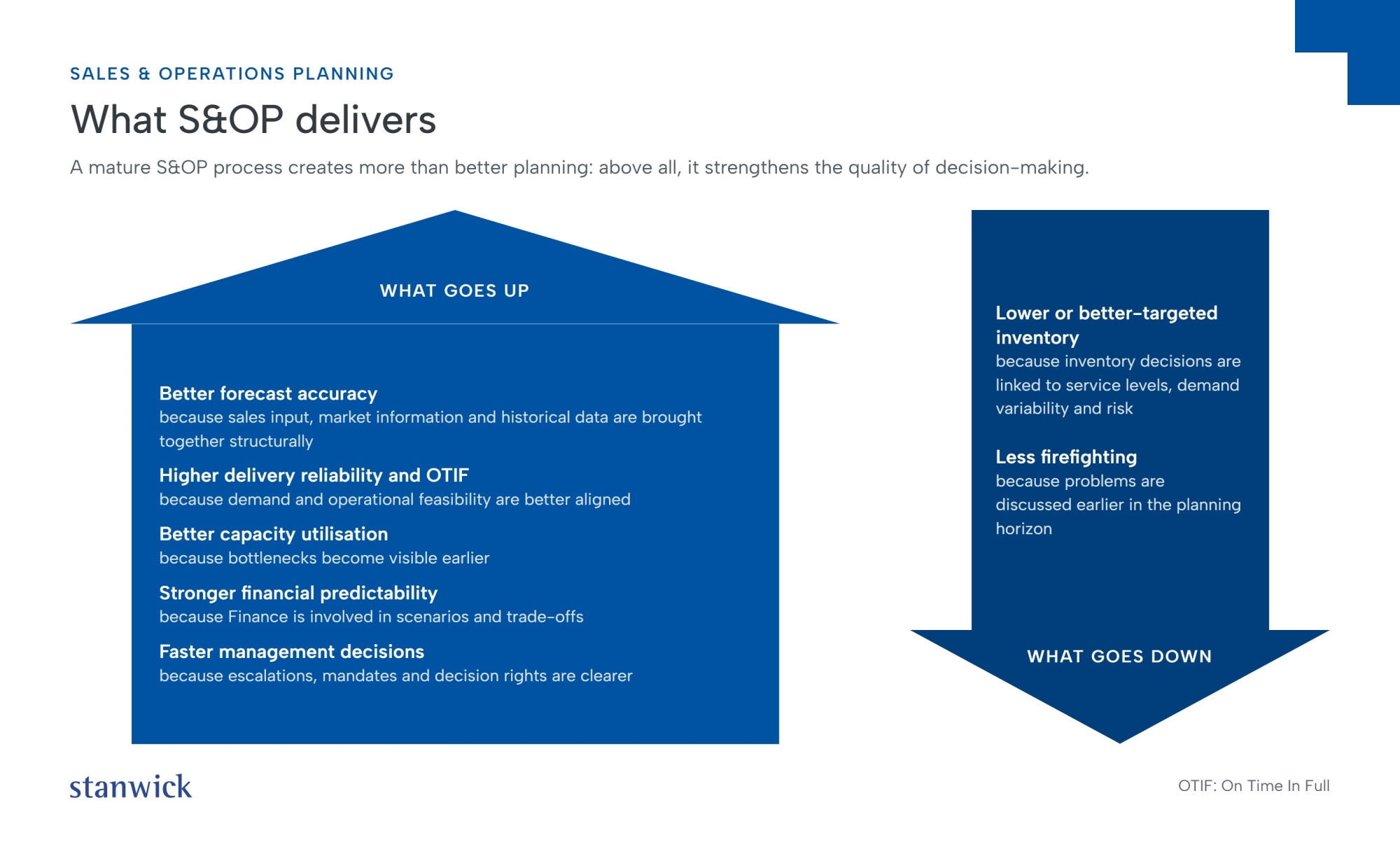
A mature S&OP process delivers more than just better planning. Above all, it enhances the quality of decision-making. APICS states that S&OP helps to align operational plans with the business plan, enables cross-functional planning, validates resources and involves senior management in supply-demand trade-offs.
Typical benefits include:
- Improved forecast accuracy because sales input, market information and historical data are systematically integrated.
- Higher delivery reliability and OTIF because demand and operational feasibility are better aligned.
- Lower or more targeted stock levels because stock decisions are linked to service levels, demand variability and risk.
- Better capacity utilisation as bottlenecks become apparent earlier.
- Greater financial predictability as Finance is involved in scenarios and trade-offs.
- Less firefighting as issues are discussed earlier in the planning horizon.
- Faster management decisions as escalations, mandates and decision-making authority are clearer.
Within Stanwick, S&OP forms part of the broader vision of Supply Chain Excellence: building flexible, agile and high-performing supply chains that can respond more quickly to unexpected events. Stanwick no longer positions supply chain management as a purely operational necessity, but as a strategic pillar for efficiency, cost reduction and customer satisfaction.
Ready to guide your organisation towards better supply chain decisions?
Do you want not only to understand S&OP, but also to apply it successfully within your organisation?
Discover how mature your current decision-making process is and where demand, capacity, stock and financial impact are not yet sufficiently aligned.
Stanwick helps organisations move from siloed planning to integrated decision-making. We support companies with:
- Supply Chain Maturity Assessment
- S&OP and IBP implementation
- Supply Chain Decision Making training and coaching
Book a consultation about your Supply Chain Decision-Making journey or discover Stanwick Academy’s Supply Chain Decision-Making Masterclass.
Further background on our Supply Chain Excellence expertise.
Discover our range of supply chain excellence training courses.
Discover recent supply chain case studies.
Contact us so we can work on solutions together.

Stanwick. Drive for results
Stanwick offers result-oriented coaching programmes on operational excellence, project excellence and supply chain excellence with a focus on people, organisations and processes. We perform thorough assessments, develop clear roadmaps and implement and anchor improvements to guarantee sustainable results.
Our Stanwick Academy organises extensive training courses in which you learn together with a like-minded community about project management, continuous improvement, data-driven organisations, leadership and change management.