



Is S&OP still relevant? Modern S&OP explained



Why this question is justified today
We are hearing the question of whether Sales & Operations Planning (S&OP) is still relevant more and more often. And to be honest: it’s a valid question. Many organisations today have an S&OP process, but see little impact from it. There are monthly meetings, dashboards, forecasts and action points, but the real decisions on capacity, stock, customer priorities, risks and financial impact are still being made on an ad hoc basis.
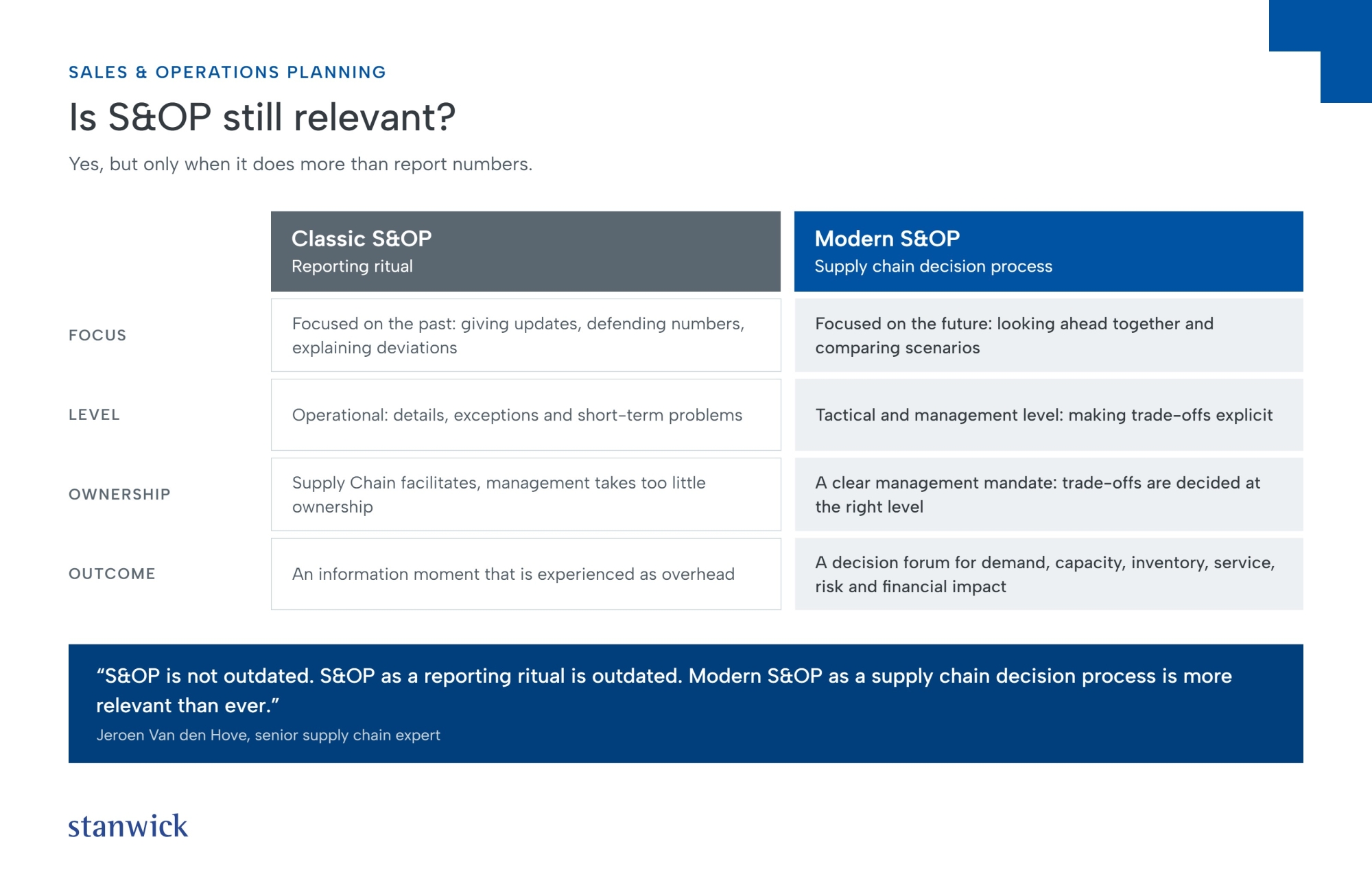
In organisations like these, S&OP is indeed outdated. Not because the concept is flawed, but because it has often been reduced to a reporting ritual. Traditional S&OP then becomes a meeting in which departments provide updates, defend figures and explain variances. Modern S&OP must be something different: a supply chain decision-making process that helps organisations make faster and better decisions on demand, supply, capacity, stock, service levels, risks and financial impact.
Traditional S&OP is often too slow, too operational and lacks decision-making capability
Many S&OP processes were originally set up based on a sound idea: to better align Sales, Operations, Supply Chain and Finance. But in practice, we often see three problems.
1. The process is too focused on the past
Teams discuss forecast accuracy, service issues, stock levels and capacity variances, but do not sufficiently consider what this means for future decisions.
2. The process remains too operational
The meeting centres on details, exceptions and short-term problems, whilst genuine S&OP decisions involve trade-offs at tactical and management level.
3. There is often a lack of a clear mandate
Supply Chain facilitates the process, but management does not take sufficient ownership. APICS emphasises precisely that S&OP brings senior executives together to resolve demand-versus-supply trade-offs and validate resources. Source: https://www.ascm.org/topics/sales-and-operations-planning
When S&OP fails to produce decisions, the process is perceived as an overhead. And in that case, the criticism is justified.
Analyse your own S&OP process
Take a moment to reflect on your own organisation and check whether you recognise the following signs.
- The meeting mainly discusses historical figures;
- Supply Chain is the sole owner;
- Sales and Finance are not sufficiently involved;
- Few genuine trade-offs are decided upon;
- Scenario planning is lacking;
- KPIs are reported, but do not guide decisions;
- Operational details dominate Executive S&OP;
- Actions are followed up, but structural decisions are not taken;
- Software and dashboards mask a weak process;
- Management views S&OP as an information-sharing session, not as a decision-making forum.
In such a context, S&OP is not worthless, but it is not sufficiently mature. There is a need to work on and further develop the Sales & Operations Planning process so that it is ready for the future.
What are the 7 characteristics of a future-proof S&OP process?
Modern supply chains do not need less S&OP, but a better version of it. Organisations must not only draw up plans, but also compare scenarios, identify risks, understand the financial impact and make decisions more quickly.
That is why the question is not:
“Is S&OP still relevant?”
But rather:
“Is our S&OP process still suitable for the decisions our supply chain needs to make today?”
In many cases, the answer is: “Not yet.”
S&OP remains highly relevant when it is structured as a rhythmic, cross-functional decision-making process.
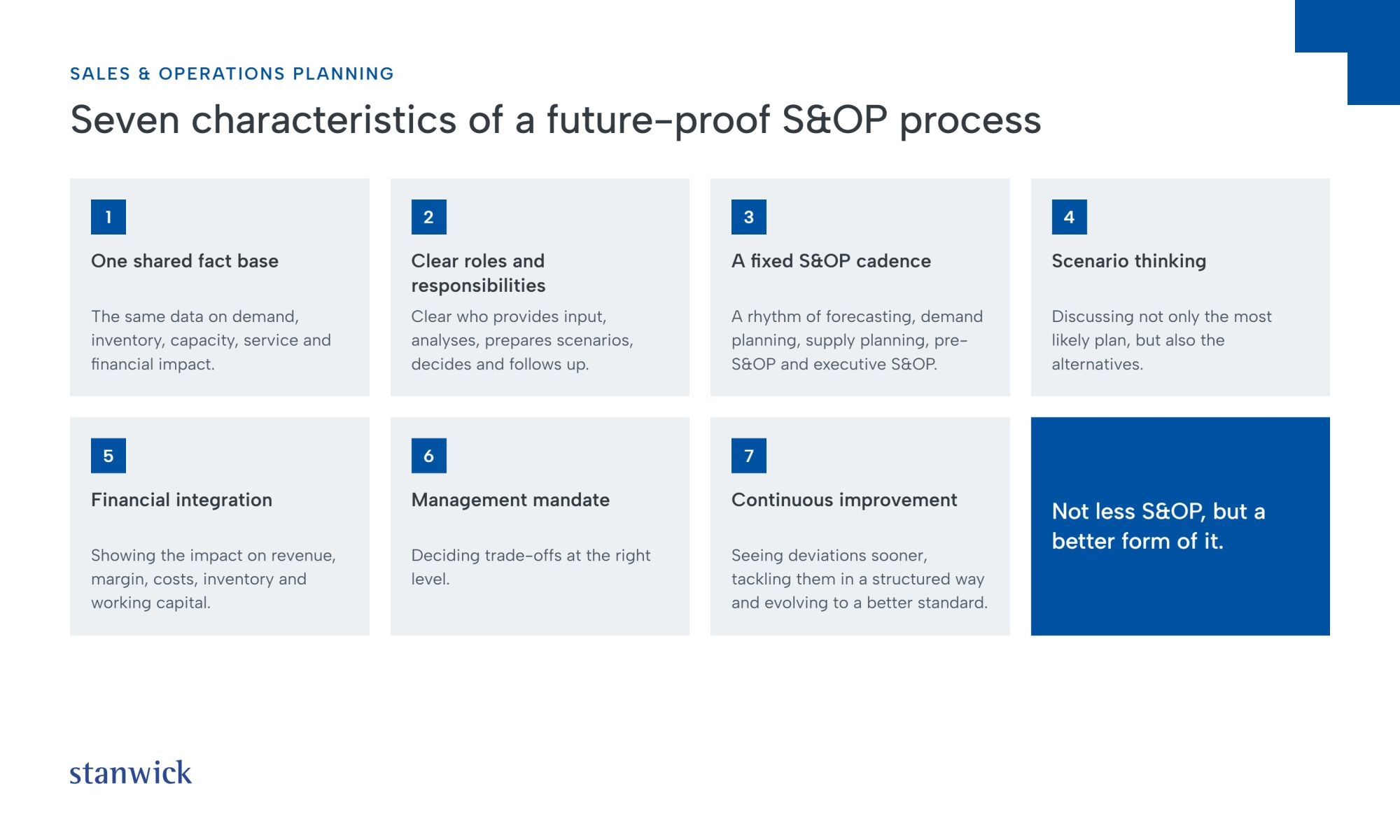
Based on our practical experience and international S&OP principles, we have identified seven characteristics found in future-proof processes.
1. A single, shared set of facts
Sales, Operations, Supply Chain and Finance work with the same data on demand, stock, capacity, service and financial impact.
2. Clear roles and responsibilities
Everyone knows who provides input, who analyses, who prepares scenarios, who makes decisions and who follows up. APICS identifies roles such as the executive champion, S&OP process owner, demand planning team, supply planning team, pre-S&OP team and executive S&OP team as key building blocks of a mature S&OP process.
3. A fixed S&OP cadence
A mature organisation maintains a consistent rhythm across forecasting, demand planning, supply planning, pre-S&OP and executive S&OP.
4. Scenario-based thinking
A future-proof S&OP process discusses not only the most likely plan, but also alternatives relating to demand, capacity, stock, risk and financial impact.
5. Financial integration
S&OP must demonstrate the impact on turnover, margin, costs, stock and working capital. Without Finance, S&OP remains too operational.
6. Management mandate
Trade-offs regarding customers, capacity, service, stock and investments must be decided at the appropriate level.
7. Continuous improvement
An S&OP process is never complete. Stanwick links S&OP to standard operating procedures and visual management: the process must help organisations to spot deviations more quickly, address them in a structured manner and continually evolve towards a higher standard.
“S&OP is not obsolete. S&OP as a reporting ritual is obsolete. Modern S&OP as a supply chain decision-making process is more relevant than ever.”
Jeroen Van den Hove – senior supply chain expert
Ready to guide your organisation towards better supply chain decisions?
Do you want not only to understand S&OP, but also to apply it successfully within your organisation?
Discover how mature your current decision-making process is and where demand, capacity, stock and financial impact are not yet sufficiently aligned.
Stanwick helps organisations move from siloed planning to integrated decision-making. We support companies with:
- Supply Chain Maturity Assessment
- S&OP and IBP implementation
- Supply Chain Decision Making training and coaching
Book a consultation about your Supply Chain Decision-Making journey or discover Stanwick Academy’s Supply Chain Decision-Making Masterclass.
Further background on our Supply Chain Excellence expertise.
Discover our range of supply chain excellence training courses.
Discover recent supply chain case studies.
Contact us so we can work on solutions together.

Stanwick. Drive for results
Stanwick offers result-oriented coaching programmes on operational excellence, project excellence and supply chain excellence with a focus on people, organisations and processes. We perform thorough assessments, develop clear roadmaps and implement and anchor improvements to guarantee sustainable results.
Our Stanwick Academy organises extensive training courses in which you learn together with a like-minded community about project management, continuous improvement, data-driven organisations, leadership and change management.