



Measuring S&OP maturity



You measure the maturity of an S&OP process not only by looking at the existence of meetings and dashboards, but above all at the quality of decision-making. A maturity assessment evaluates how processes, data, KPIs, roles, technology and collaboration contribute to better decisions regarding demand, capacity, stock and financial impact.
Why measure S&OP maturity?
Measuring S&OP maturity helps to objectively determine how effectively your organisation aligns demand, capacity, stock, financial objectives and decision-making. The assessment highlights where the process is currently being held up, which foundations are already strong, and where departments are still operating on the basis of differing figures or priorities. This helps you avoid improvement initiatives being based solely on perceptions or isolated symptoms.
The 5 levels of S&OP maturity
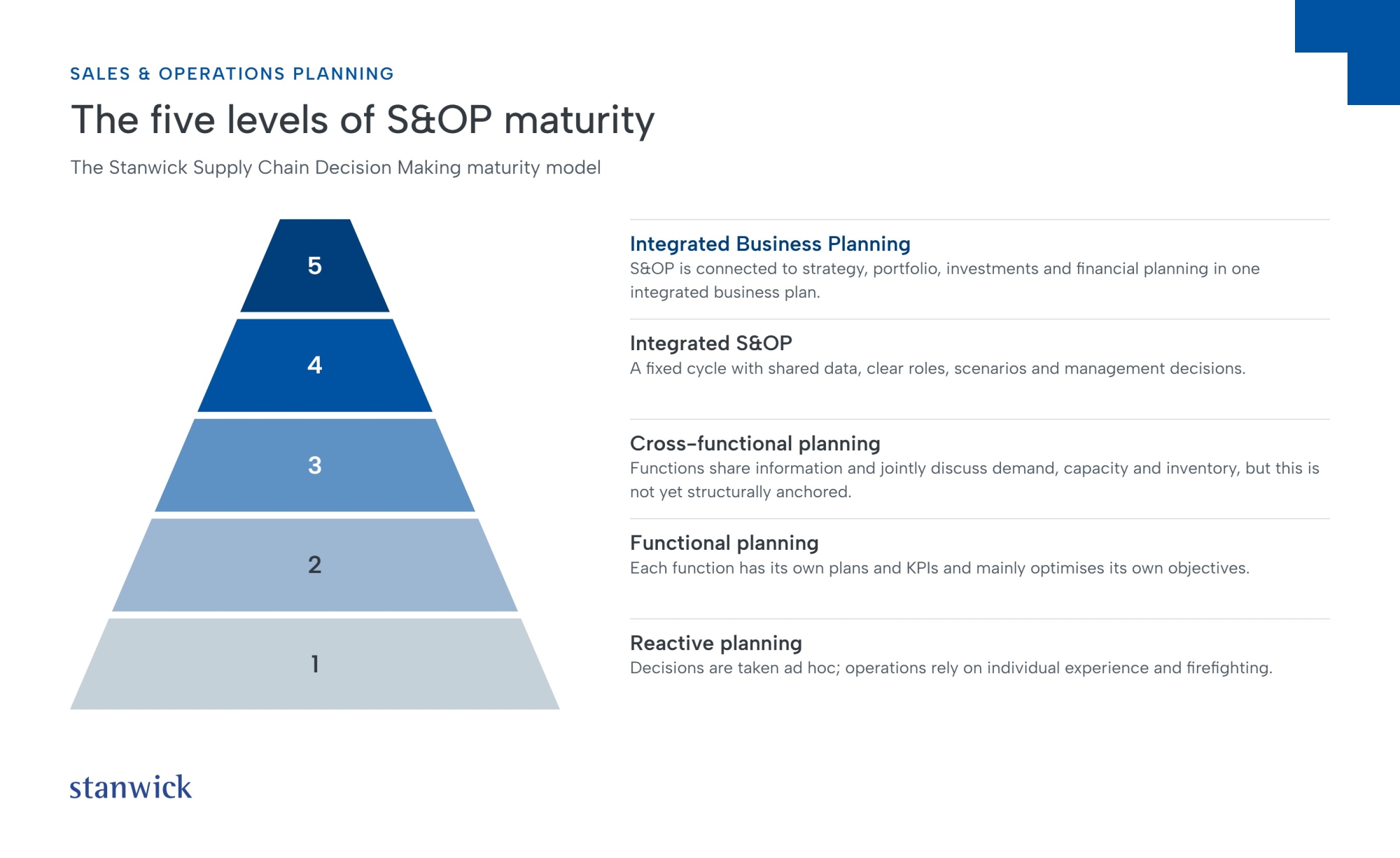
The Stanwick Supply Chain Decision Making maturity model consists of 5 levels:
- Reactive planning
Decisions are mainly taken on an ad hoc basis when shortages, capacity issues or customer enquiries arise. Operations rely heavily on individual experience and operational firefighting. - Functional planning
Sales, Operations, Supply Chain and Finance have their own plans and KPIs, but these are only aligned to a limited extent. Each function primarily optimises its own objectives. - Cross-functional planning
The various functions share information and jointly discuss demand, capacity and stock. Greater alignment is achieved, but decision-making authority, scenarios and financial integration are not yet always structurally embedded. - Integrated S&OP
The organisation operates according to a fixed cycle with shared data, clear roles, scenarios and management decisions. Operational and financial implications are assessed jointly, and actions are assigned an owner and followed up. - Integrated Business Planning
S&OP is linked to strategy, portfolio, investments and financial planning. Management uses a single integrated business plan to look ahead, compare scenarios and set organisation-wide priorities.
Dimensions of a maturity assessment
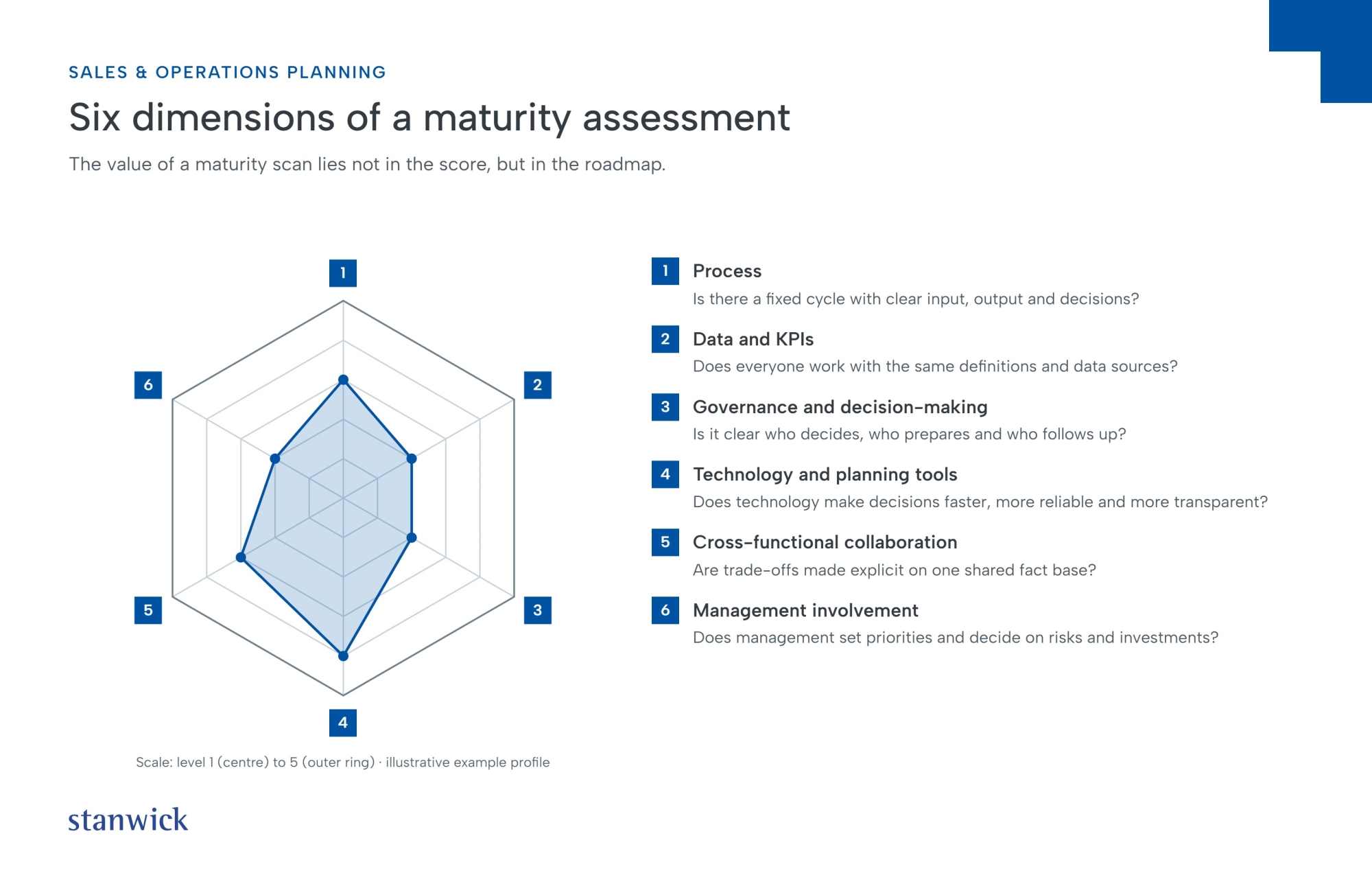
A robust assessment examines process, data, KPIs, governance, technology, collaboration and management commitment. In doing so, assess not only what is formally documented, but above all how the process is actually carried out. A well-designed process diagram means little if, in practice, teams use different figures or make decisions outside the S&OP cycle.
1. Process maturity
Process maturity assesses whether the organisation has a fixed S&OP cycle with clear inputs, outputs, a timetable and decisions. For example, check whether the Demand Review, Supply Review, Pre-S&OP and Executive S&OP have a clear purpose and follow on logically from one another. In a mature cycle, it is also clear which decisions are prepared, taken and followed up at each stage.
2. Data and KPI maturity
Data and KPI maturity examines forecast accuracy, data quality, KPI definitions, dashboarding and confidence in figures. Do Sales, Operations, Supply Chain and Finance work with the same definitions and data sources? A mature organisation uses a limited set of KPIs that highlight deviations, risks and trade-offs, rather than an extensive dashboard that primarily reports on historical performance.
3. Governance and Decision-Making
Governance determines who decides, who prepares, who provides input and who is responsible for follow-up. Without clear decision-making authority, S&OP remains a consultation process without the power to enforce decisions. You should therefore assess whether roles and escalation rules are clear, whether management decisions are taken in a timely manner, and whether every decision is assigned an owner, a deadline and an expected impact.
4. Technology and planning tools
Technology supports maturity but does not replace it. Planning tools can link data, compare scenarios and support collaboration, but they do not resolve unclear roles or poor governance. The key question is therefore not how much software you use, but whether the technology enables the right decisions to be made more quickly, reliably and transparently.
5. Cross-functional collaboration
S&OP maturity depends heavily on collaboration between Sales, Operations, Supply Chain, Finance and Management. Each function brings a different perspective, making tensions over growth, capacity, service, stock and working capital inevitable. A mature organisation does not avoid these tensions, but uses a single, shared set of facts to make trade-offs explicit and take well-supported decisions.
6. Management involvement
Management involvement determines whether S&OP becomes a reporting process or a genuine decision-making process. Senior management need not discuss every operational detail, but must set priorities and decide on risks, capacity, investments and financial impact. Without a sufficient mandate, difficult choices are deferred to the next cycle.
From maturity scan to roadmap
The value of a maturity scan lies not in the score, but in the roadmap. Translate the findings into a limited number of improvement priorities: what quick wins are possible, what capabilities are missing, and what data or governance issues are blocking better decisions? Combine actions that can be implemented quickly with structural improvements relating to process, ownership, data quality, scenario analysis and financial integration.
A good roadmap also makes it clear what needs to be done first. For example, new planning software is of little value if KPI definitions, roles and decision-making authority are still unclear. In this way, your organisation will gradually evolve from reactive planning to an integrated management process that delivers better decisions with every cycle.
Ready to guide your organisation towards better supply chain decisions?
Do you want not only to understand S&OP, but also to apply it successfully within your organisation?
Discover how mature your current decision-making process is and where demand, capacity, stock and financial impact are not yet sufficiently aligned.
Stanwick helps organisations move from siloed planning to integrated decision-making. We support companies with:
- Supply Chain Maturity Assessment
- S&OP and IBP implementation
- Supply Chain Decision Making training and coaching
Book a consultation about your Supply Chain Decision-Making journey or discover Stanwick Academy’s Supply Chain Decision-Making Masterclass.
Further background on our Supply Chain Excellence expertise.
Discover our range of supply chain excellence training courses.
Discover recent supply chain case studies.
Contact us so we can work on solutions together.

Stanwick. Drive for results
Stanwick offers result-oriented coaching programmes on operational excellence, project excellence and supply chain excellence with a focus on people, organisations and processes. We perform thorough assessments, develop clear roadmaps and implement and anchor improvements to guarantee sustainable results.
Our Stanwick Academy organises extensive training courses in which you learn together with a like-minded community about project management, continuous improvement, data-driven organisations, leadership and change management.