



Why Supply Chain Decision Making is crucial



We operate in a VUCA market context
Supply chains today operate in an environment characterised by increasing volatility, complexity and uncertainty. Stanwick explicitly refers to this context as VUCA (volatile, uncertain, complex and ambiguous). Demand patterns are changing more rapidly, capacity is under pressure and customers expect ever-higher service levels.
In our supply chain and warehouse assessments, we regularly observe the same tension: total stock levels are high, yet certain critical products are still unavailable. The problem then lies not only in the quantity of stock, but also in the product mix, location and alignment with actual customer demand. Every perspective is valuable. However, without an integrated decision-making process, conflicting priorities, unclear trade-offs and decisions that are made too late, too operationally focused or at the wrong organisational level arise.
ASCM (Association for Supply Chain Management) emphasises that: “S&OP helps organisations align day-to-day activities with business strategy, better balance supply and demand, work with a single set of figures and identify potential bottlenecks in good time.” (Source: https://www.ascm.org/topics/sales-and-operations-planning)
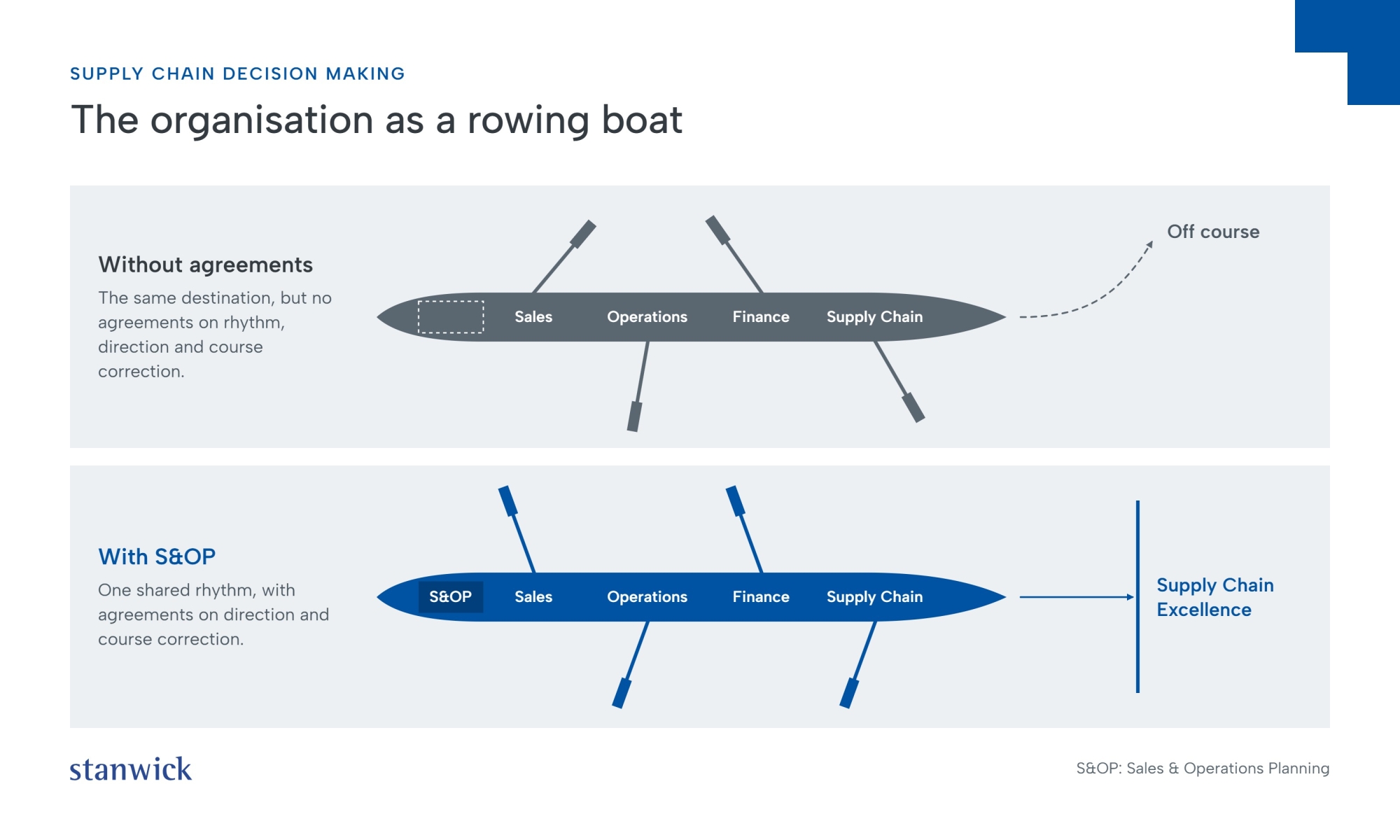
Supply Chain Decision Making as a rowing boat
At Stanwick, we often use the metaphor of a rowing boat: Sales, Operations, Finance and Supply Chain may share the same ultimate goal, but without agreements on rhythm, direction and course corrections, the organisation will veer off course. S&OP creates that shared rhythm and ensures the organisation moves towards Supply Chain Excellence.
The aim, therefore, is not to create more meetings, but to make decisions more quickly, in a better-informed and cross-functional manner. At Stanwick, we therefore do not view Sales & Operations Planning (S&OP) and Integrated Business Planning (IBP) as a traditional planning process, but as one of the most important mechanisms for strengthening supply chain decision-making.
In this context, the difference is no longer made by more data, but by better decisions. That is why ad hoc adjustments are no longer sufficient today. Organisations need a fixed rhythm in which Sales, Operations, Supply Chain, Finance and Management look ahead together, compare scenarios and make explicit choices.
Modern supply chain decision-making is not about the perfect forecast, but about making the right decision when reality deviates from the plan.
FMCG and food: commercial peaks vs. feasibility
Among manufacturers of consumer goods, we often see that promotions or seasonal peaks in demand cause significant fluctuations in the forecast. The KPIs then often tell a contradictory story: commercial growth is rising, but at the same time OTIF is falling, overtime is increasing and production lines are being reconfigured more frequently. The challenge lies not in predicting every peak, but in explicitly balancing service level, capacity and margin when demand exceeds available capacity.
The management decision may then be to limit the promotion, build up stock in advance, deploy additional capacity temporarily, or accept a lower service level for lower-priority products.
Which KPIs come under pressure during commercial demand peaks?
- OTIF (On Time In Full)
- Forecast Accuracy
- Production line utilisation
- Overtime
- Service Level
Manufacturing companies: growth vs. capacity
In manufacturing environments, we regularly see Sales developing ambitious growth plans whilst Operations is reaching capacity limits. Decisions regarding product mix, customer priorities and investments are then often taken on an ad hoc basis. This creates a constant tension between forecasts, available capacity and delivery reliability. A mature S&OP process makes these trade-offs visible and open to discussion before they manifest as backlogs or escalations.
Management must explicitly decide which product families and customers take priority, whether additional capacity is financially and strategically justifiable, and which backlogs are temporarily acceptable.
Which KPIs come under pressure when capacity is strained?
- Capacity utilisation
- Schedule adherence
- Backlog
- Lead time
- Service level
“A high total stock level is no guarantee of high availability. The product mix, location and alignment with customer demand determine whether stock actually delivers service.”
Jeroen Van den Hove – senior supply chain management expert
Distribution and warehousing: stock vs. availability
In our supply chain and warehouse assessments, we regularly observe a striking combination: warehouses are well-stocked, yet critical products are still unavailable. Total stock levels appear high, but the stock is not in the right place or consists of the right products. As a result, objectives relating to working capital, availability and logistical efficiency are constantly at odds with one another.
The decision is therefore not just about reducing stock, but about which products need to be available at which location and what service level is economically viable for each customer or product segment.
Which KPIs come under pressure when stock issues arise?
- Stock turnover
- Stock coverage
- DIO (Days’ Inventory Outstanding)
- Service level
- OTIF (On Time In Full), Delivery Reliability
- Working Capital
In short: Supply Chain Decision Making helps organisations make explicit choices regarding demand, capacity, stock, service, risk and financial impact in a volatile environment. S&OP and IBP establish the rhythm in which functions compare scenarios and management decides on trade-offs.
Ready to guide your organisation towards better supply chain decisions?
Do you want not only to understand S&OP, but also to apply it successfully within your organisation?
Discover how mature your current decision-making process is and where demand, capacity, stock and financial impact are not yet sufficiently aligned.
Stanwick helps organisations move from siloed planning to integrated decision-making. We support companies with:
- Supply Chain Maturity Assessment
- S&OP and IBP implementation
- Supply Chain Decision Making training and coaching
Book a consultation about your Supply Chain Decision-Making journey or discover Stanwick Academy’s Supply Chain Decision-Making Masterclass.
Further background on our Supply Chain Excellence expertise.
Discover our range of supply chain excellence training courses.
Discover recent supply chain case studies.
Contact us so we can work on solutions together.

Stanwick. Drive for results
Stanwick offers result-oriented coaching programmes on operational excellence, project excellence and supply chain excellence with a focus on people, organisations and processes. We perform thorough assessments, develop clear roadmaps and implement and anchor improvements to guarantee sustainable results.
Our Stanwick Academy organises extensive training courses in which you learn together with a like-minded community about project management, continuous improvement, data-driven organisations, leadership and change management.