



10 key elements for a successful S&OP process



What makes for a successful S&OP process?
Based on our experience in numerous supply chain and S&OP projects, we’ve found that successful organisations do not necessarily have the most complex tools. Above all, they have discipline, clear roles, reliable data, management commitment and the courage to discuss real trade-offs. We’ll take a closer look at ten practical tips drawn from real-world experience.
With these ten building blocks, you can turn S&OP into a process that leads to faster decisions, identifies risks earlier and aligns commercial, operational and financial plans.
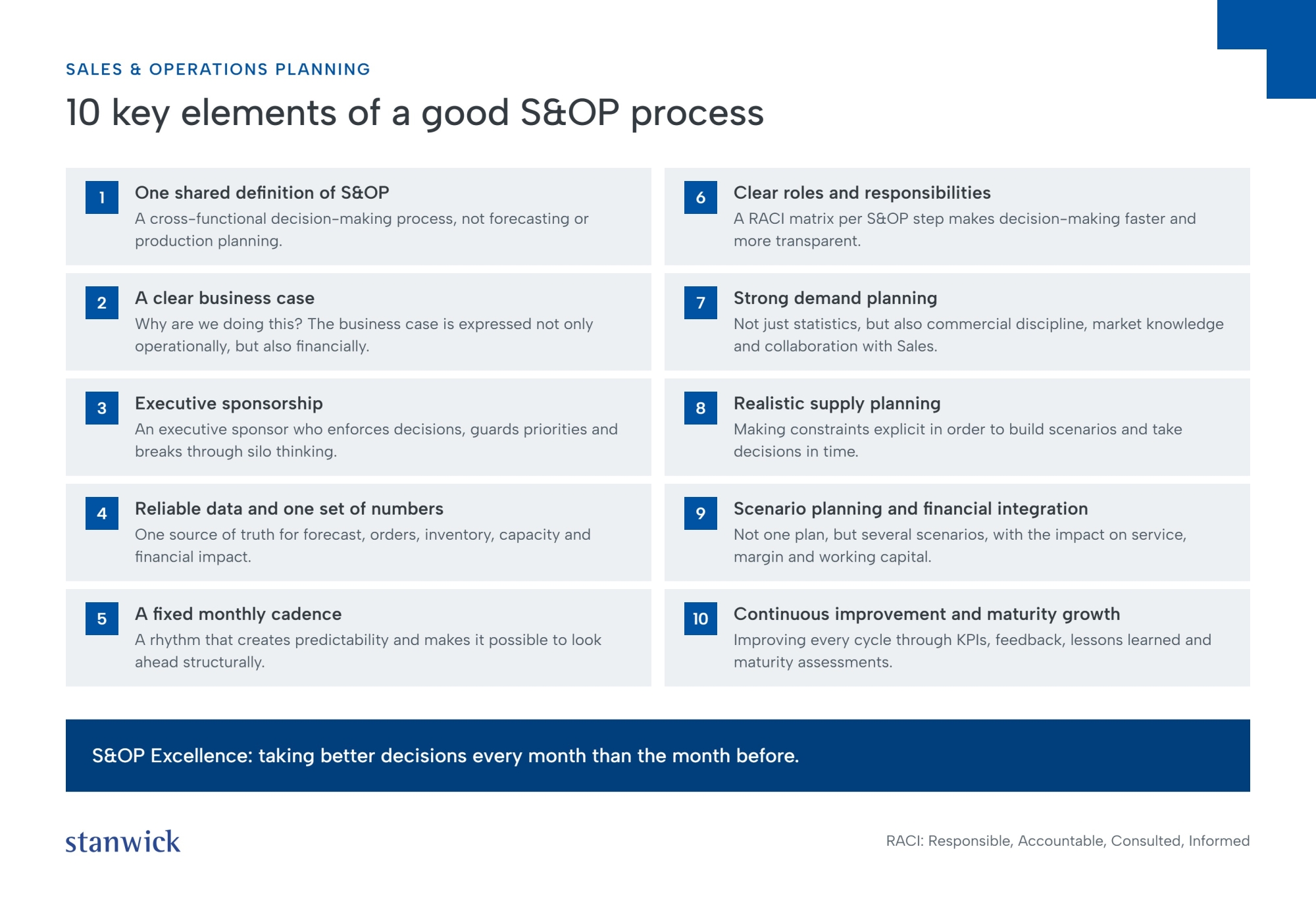
1. A single, shared definition of S&OP
The first key element is a clear definition. S&OP is often confused with forecasting, production planning or a supply chain meeting. That is too narrow a view. S&OP is a cross-functional decision-making process in which demand, supply, capacity, stock and financial impact are integrated.
Without a shared understanding, confusion arises about who is responsible, what decisions are taken and what the output should be.
2. A clear business case
A good S&OP process starts with the question: why are we doing this? Possible drivers include low forecast accuracy, high stock levels, poor OTIF, capacity issues, pressure on working capital or insufficient commercial predictability. That is why the business case must be expressed not only in operational terms but also in financial terms.
3. Executive sponsorship
Without senior management support, S&OP often gets bogged down in reporting. A strong S&OP cycle has an executive sponsor who enforces decisions, monitors priorities and breaks down silos.
4. Reliable data and a single set of figures
S&OP stands or falls on trust in the data. If Sales, Supply Chain and Finance each work with different figures, the meeting becomes a discussion about definitions rather than decisions. A strong S&OP organisation works with a single source of truth for forecasts, orders, stock, capacity and financial impact.
5. A fixed monthly cadence
A good S&OP process has rhythm. Most organisations operate on a monthly cycle comprising data review, demand review, supply review, pre-S&OP and executive S&OP. This cadence creates predictability and enables a structured forward-looking approach.
Read more about this in the following articles:
How often do you organise an S&OP cycle?
What is sales & operations planning? Definition, process and benefits of S&OP.
6. Clear roles and responsibilities
Without clear roles, your S&OP cycle will get bogged down in consultation. You should therefore define, for each process step, who provides input, who validates it and who makes the decisions. Who provides forecast input? Who validates capacity? Who translates scenarios into financial impact? Who makes the decisions?
A RACI (Responsible, Accountable, Consulted, Informed) matrix for each S&OP step is therefore essential. Not to create bureaucracy, but to make decision-making faster and more transparent.
7. Strong demand planning
Demand planning often marks the start of the S&OP cycle. Without reliable demand input, supply planning becomes reactive.
Our experience: good demand planning is not just about statistics. It also requires commercial discipline, market knowledge and collaboration with Sales.
8. Realistic supply planning
Supply planning translates demand into operational feasibility. This involves assessing capacity, materials, suppliers, stock and bottlenecks. A robust S&OP process makes constraints explicit. Not to escalate problems, but to build scenarios and make timely decisions.
9. Scenario planning and financial integration
A mature S&OP organisation does not discuss a single plan, but multiple scenarios. What if demand is 15 per cent higher? What if a supplier fails? What if stock levels need to be reduced? What is the impact on service levels, margins and working capital?
Integrated Business Planning (IBP) takes this a step further by structurally linking strategy, portfolio, demand, supply and financial plans.
10. Continuous improvement and maturity growth
S&OP is never ‘finished’. A good process is continually improved through KPIs, feedback, lessons learnt and maturity assessments.
“The best organisations do not use S&OP to explain the past, but to better steer the future. For us, that is the essence of S&OP Excellence: making better decisions every month than the month before.”
Jeroen Van den Hove – senior supply chain expert
Key takeaway
A good S&OP process is based on ten elements: clear definition, business case, executive sponsorship, reliable data, monthly cadence, roles, demand planning, supply planning, scenario planning and continuous improvement. Those who master these elements will evolve from siloed planning to integrated business management.
Ready to guide your organisation towards better supply chain decisions?
Do you want not only to understand S&OP, but also to apply it successfully within your organisation?
Discover how mature your current decision-making process is and where demand, capacity, stock and financial impact are not yet sufficiently aligned.
Stanwick helps organisations move from siloed planning to integrated decision-making. We support companies with:
- Supply Chain Maturity Assessment
- S&OP and IBP implementation
- Supply Chain Decision Making training and coaching
Book a consultation about your Supply Chain Decision-Making journey or discover Stanwick Academy’s Supply Chain Decision-Making Masterclass.
Further background on our Supply Chain Excellence expertise.
Discover our range of supply chain excellence training courses.
Discover recent supply chain case studies.
Contact us so we can work on solutions together.

Stanwick. Drive for results
Stanwick offers result-oriented coaching programmes on operational excellence, project excellence and supply chain excellence with a focus on people, organisations and processes. We perform thorough assessments, develop clear roadmaps and implement and anchor improvements to guarantee sustainable results.
Our Stanwick Academy organises extensive training courses in which you learn together with a like-minded community about project management, continuous improvement, data-driven organisations, leadership and change management.