



How often do you organise an S&OP cycle?



Why S&OP usually takes place monthly?
A Sales & Operations Planning cycle is organised monthly in most organisations. This monthly rhythm makes sense: S&OP must be frequent enough to discuss changes in demand, capacity, stock, service and financial impact in good time, but must not get bogged down in day-to-day operational adjustments.
The typical S&OP calendar
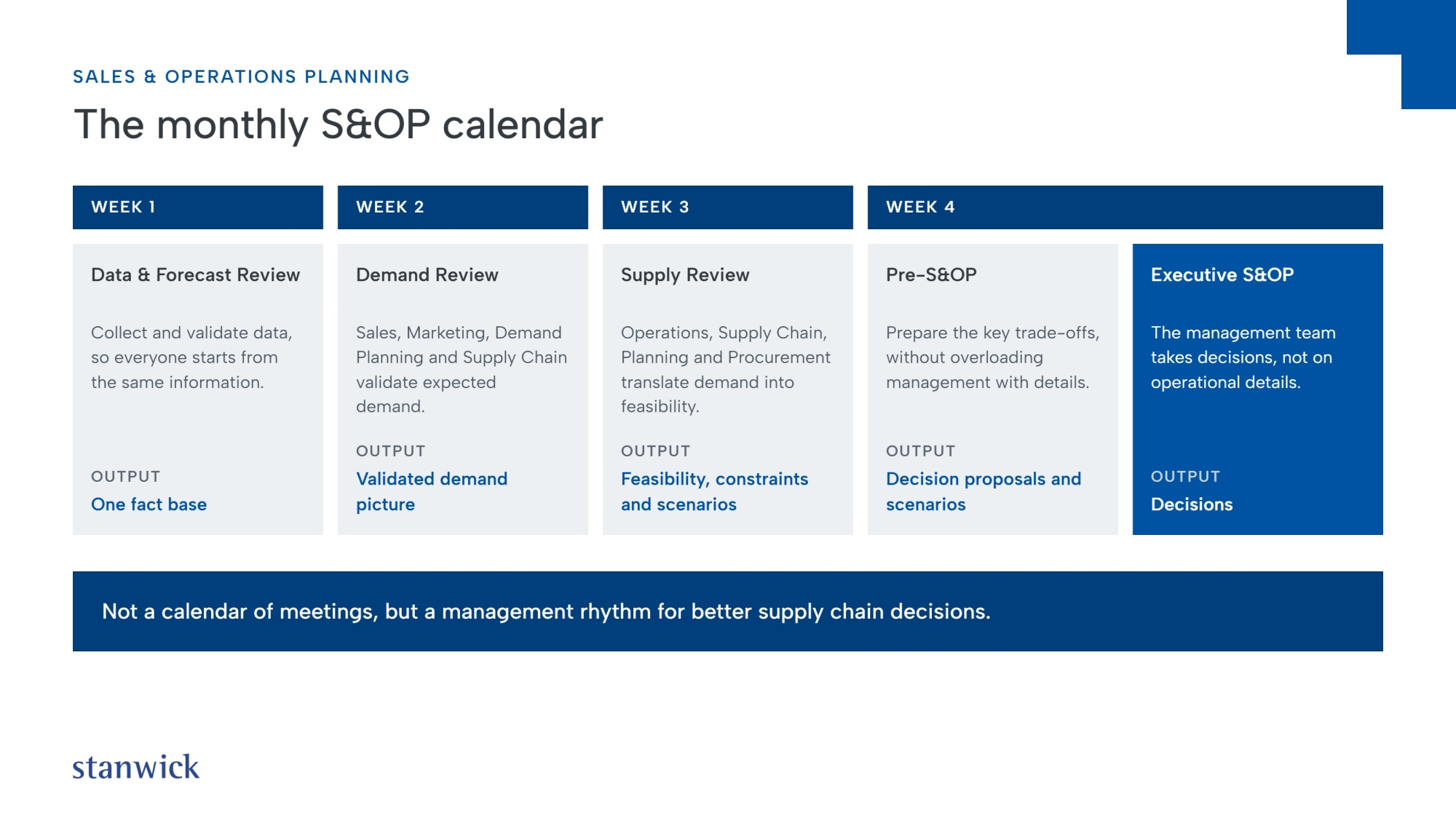
A mature S&OP cycle usually consists of a fixed monthly calendar. This calendar provides clarity: everyone knows when input is expected, when scenarios are prepared and when management decisions are taken.
A commonly used structure is:
Week 1: Data & Forecast Review
Week 2: Demand Review
Week 3: Supply Review
Week 4: Pre-S&OP and Executive S&OP
This structure aligns with the S&OP flow as described by ASCM: first forecasting and demand planning, followed by supply planning, then pre-S&OP and finally executive S&OP.
It is important that each step has clear input, output, owner and decision-making logic. Without that discipline, the cycle quickly becomes a series of meetings with no impact.
Week 1: Data and forecast review
The first week centres on the factual basis. Otherwise, we end up with ‘garbage in, garbage out’. The organisation collects and validates data relating to:
- historical sales
- open orders
- forecast variances
- forecast accuracy and forecast bias
- stock levels
- service level and OTIF
- capacity information
- promotions, market insights and commercial campaigns
- financial parameters such as revenue forecasts and working capital
The aim of this step is not to make any decisions yet, but to ensure that everyone is working from the same information.
From a Stanwick perspective, this is a crucial step. If Sales, Operations, Supply Chain and Finance are working with different figures, the rest of the S&OP cycle will mainly become a discussion about data rather than about decisions.
Week 2: Demand review
The second week centres on the Demand Review. Here, Sales, Marketing, Demand Planning and Supply Chain validate the expected demand.
Typical topics include:
- expected customer demand
- promotions and commercial campaigns
- new or lost customers
- market developments
- product launches or phase-outs
- forecast accuracy
- forecast bias
- consensus forecast
The aim is to arrive at a validated demand picture. Not only based on historical data, but also on commercial insights, customer information and market expectations.
A good Demand Review is not a discussion about who was right in the previous forecast. It is a discussion about which assumptions are most realistic today and which uncertainties must be explicitly taken into account in the next step.
Week 3: Supply review
In the third week, demand is translated into operational feasibility. The Supply Review is usually prepared and led by Operations, Supply Chain, Planning, Procurement and, where relevant, Logistics or Warehousing.
Typical questions include:
- Can we meet the expected demand?
- Is there sufficient production capacity?
- Where are the bottlenecks?
- Are critical materials available?
- Which suppliers pose a risk?
- What stock levels are required?
- What is the impact on service levels, costs and working capital?
ASCM explicitly identifies supply planning as the stage in which sales, finance, operations and other departments assess the organisation’s capacity in terms of people, suppliers and production.
The output of this step is a clear picture of feasibility, constraints and possible scenarios. A robust Supply Review highlights constraints before they turn into operational crises.
Week 4: Pre-S&OP and Executive S&OP
In the fourth week, demand and supply are brought together. This takes place in two steps: Pre-S&OP and Executive S&OP.
Step 1: Pre-S&OP
During Pre-S&OP, the key trade-offs are prepared. These include choices between:
- service level and stock
- commercial opportunities and available capacity
- delivery reliability and costs
- working capital and availability
- customer priorities and product mix
- risks and buffers
The aim is not to overwhelm management with details, but to prepare clear decision proposals and scenarios.
Step 2: Executive S&OP
In Executive S&OP, the management team makes decisions. Executive S&OP should therefore not focus on operational details. It should focus on decisions such as:
- Which customers or markets take priority?
- Do we accept a lower service level or do we build up stock?
- Do we invest in additional capacity?
- Do we adjust the commercial plan?
- Which risks do we consciously accept?
- What is the financial impact of the chosen scenarios?
This is where S&OP truly becomes a supply chain decision-making process.
At Stanwick, we do not view the S&OP cycle as a calendar of meetings, but as a management rhythm for better supply chain decisions.
What planning horizon do you use for the S&OP planning meeting?
An S&OP cycle usually looks 12 to 18 months ahead. This horizon is long enough to discuss capacity decisions, stock strategies, commercial plans and supply chain risks in good time.
In the context of S&OP, APICS refers to a horizon that at least supports the annual business plan and is ideally long enough to plan resources and capacities. A horizon of approximately 18 months is cited as ideal for S&OP planning.
The appropriate horizon depends on the sector:
- In FMCG or retail, the emphasis may be more on short cycles, promotions and seasonal patterns.
- In the manufacturing industry, capacity, material availability and product family planning may carry greater weight.
- In project-based or engineer-to-order environments, a longer horizon is often required due to longer lead times.
- In pharmaceuticals, chemicals or food, regulations, shelf life, batch sizes and quality requirements also play a role.
It is important that the horizon is long enough to still allow decisions to be made. If problems only become apparent when they are operationally unavoidable, S&OP comes too late.
How do you combine S&OP with S&OE?
A monthly S&OP cycle is not intended to resolve all day-to-day operational disruptions. For that, you need a shorter cyclical process: Sales & Operations Execution (S&OE).
Gartner (www.gartner.com) introduced S&OE as a process that supports the S&OP cycle by separating detailed execution management from S&OP. Gartner describes S&OE as an often-overlooked process that is essential for S&OP to realise its full value.
S&OE is therefore more like a weekly or even more frequent planning process designed to tackle execution-level supply and demand imbalances, whilst S&OP focuses on the strategic-tactical plan. Both processes are necessary. Without S&OP, S&OE becomes mere firefighting. Without S&OE, S&OP becomes a plan that gradually loses touch with reality.
The distinction is essential:
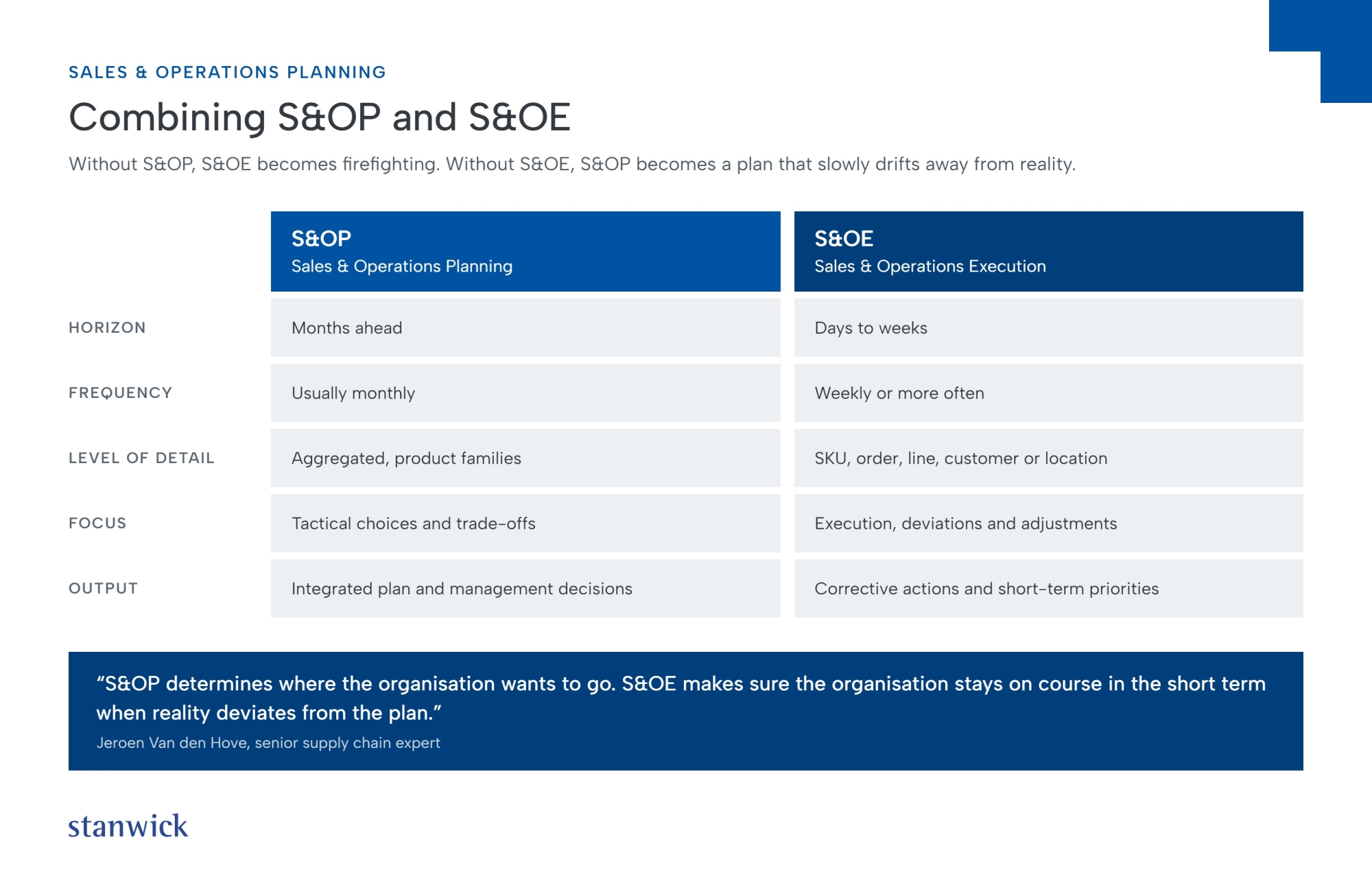
At Stanwick, we like to summarise it as follows:
“S&OP determines where the organisation wants to go. S&OE ensures that the organisation stays on course in the short term when reality deviates from the plan.”
Jeroen Van den Hove – senior supply chain expert
How do you prevent the S&OP cycle from becoming a reporting ritual?
One of the biggest pitfalls is that S&OP degenerates into a monthly reporting meeting. Figures are presented, variances are explained, and everyone carries on without any real decisions being made.
A robust S&OP cycle avoids this by applying five principles:
Principle 1: Start with decisions, not slides
Every meeting must make it clear: what decisions need to be taken today?
Principle 2: Report exceptions, not everything
Not every figure warrants discussion. Focus on variances, risks, bottlenecks and scenarios. Red lights are more important than green lights.
Principle 3: Make trade-offs explicit
S&OP must highlight trade-offs between service levels, stock, capacity, costs, margin and working capital.
Principle 4: Involve Finance systematically
Without a financial translation, S&OP remains too operational. Finance must help to quantify scenarios.
Principle 5: Ensure a management mandate
Executive S&OP must be able to make decisions. Otherwise, escalations get bogged down between departments. S&OP helps the management team to understand challenges and act on them according to the correct priorities.
Ready to guide your organisation towards better supply chain decisions?
Do you want not only to understand S&OP, but also to apply it successfully within your organisation?
Discover how mature your current decision-making process is and where demand, capacity, stock and financial impact are not yet sufficiently aligned.
Stanwick helps organisations move from siloed planning to integrated decision-making. We support companies with:
- Supply Chain Maturity Assessment
- S&OP and IBP implementation
- Supply Chain Decision Making training and coaching
Book a consultation about your Supply Chain Decision-Making journey or discover Stanwick Academy’s Supply Chain Decision-Making Masterclass.
Further background on our Supply Chain Excellence expertise.
Discover our range of supply chain excellence training courses.
Discover recent supply chain case studies.
Contact us so we can work on solutions together.

Stanwick. Drive for results
Stanwick offers result-oriented coaching programmes on operational excellence, project excellence and supply chain excellence with a focus on people, organisations and processes. We perform thorough assessments, develop clear roadmaps and implement and anchor improvements to guarantee sustainable results.
Our Stanwick Academy organises extensive training courses in which you learn together with a like-minded community about project management, continuous improvement, data-driven organisations, leadership and change management.