



How do you get started with S&OP in your organisation?



H2: When is your organisation ready for S&OP?
An organisation is ready for S&OP when growth, complexity, stock levels, delivery reliability or capacity planning can no longer be managed through ad hoc meetings. Typical signs include conflicting figures between departments, forecasts that are not trusted enough, and capacity issues that only become apparent when it is almost impossible to make adjustments.
S&OP becomes particularly relevant when problems can no longer be resolved by a single department. It brings Sales, Operations, Supply Chain, Finance and Management together around a single set of facts and a single, widely supported plan.
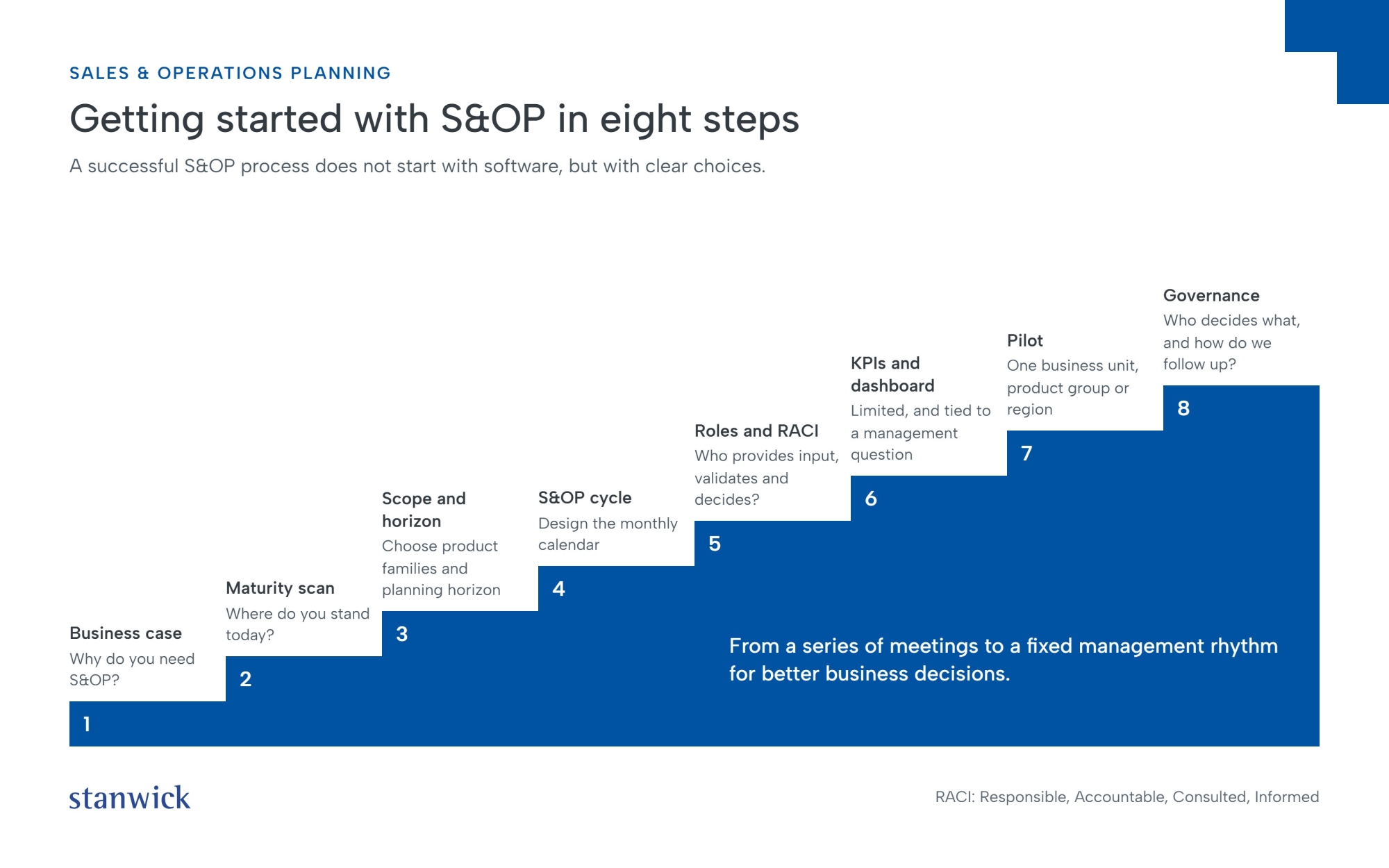
Step 1: Draw up a business case
Start by asking: why does your organisation need S&OP? Possible drivers include forecasting problems, high stock levels, low OTIF, capacity conflicts or insufficient financial predictability.
Then translate these bottlenecks into concrete business impacts. For example, highlight how much turnover is lost due to stock-outs, how much working capital is tied up in excess stock, or what additional costs arise from urgent deliveries, overtime and frequent planning changes. In this way, S&OP becomes not just a supply chain initiative, but a solution to a recognisable business challenge.
Step 2: Carry out an S&OP maturity scan
A maturity scan reveals where your organisation currently stands in terms of processes, roles, data, KPIs, software, governance and collaboration. When doing so, look not only at what is formally documented, but above all at how decisions are prepared, taken and followed up in practice.
The aim is not to assign your organisation a score or label. The scan should reveal which foundations are already in place, where decisions are currently being held up, and which improvements are needed first. Translate the results straight away into a feasible roadmap with quick wins and structural actions.
Step 3: Define scope, product families and planning horizon
Do not start too broadly. Choose clear product families, a relevant planning horizon and a scope that remains manageable for the teams involved.
Group products at a level where management can make meaningful decisions. Too much SKU detail makes discussions overly operational, whilst too high a level of aggregation can conceal significant capacity or stock risks. Also ensure that the horizon is long enough to allow for intervention before capacity shortages, material issues or commercial
Step 4: Design the monthly S&OP cycle
Draw up the calendar to include a data review, demand review, supply review, pre-S&OP and executive S&OP. For each step, specify what input is required, what output is expected and what decisions need to be taken or prepared.
Each meeting must have a clear purpose. The Demand Review establishes a single, agreed demand forecast; the Supply Review assesses that plan against capacity and availability; and Pre-S&OP works through the key scenarios and trade-offs. In Executive S&OP, management then makes decisions on priorities, risks, investments and financial impact.
Step 5: Define roles and RACI
S&OP does not work without ownership. Determine who provides forecast input, who validates supply constraints, who prepares scenarios and who ultimately makes the decisions.
Therefore, for each process step and key decision point, draw up a RACI matrix: who is Responsible, Accountable, Consulted and Informed? Above all, make it clear who has final responsibility, as shared responsibility often leads to delayed decisions in practice. A good RACI matrix reduces grey areas and makes escalations faster and more transparent.
Step 6: Select KPIs and dashboard
Start with a limited dashboard focusing on forecast accuracy, OTIF, stock levels, capacity and financial impact. Select only those KPIs that support a specific management question and can lead to an action or decision.
For each KPI, also define its definition, data source, reporting frequency and owner. Otherwise, the S&OP meeting risks getting bogged down in discussions about figures. The dashboard should not aim to display as much information as possible, but rather to quickly highlight deviations, risks and trade-offs.
Step 7: Start with a pilot
A pilot enables learning. Choose one business unit, product group or region where the need is clear, the data is sufficiently reliable and the managers involved are willing to collaborate.
By starting on a small scale, you can test roles, KPIs, review meetings and decision-making rules in practice. Define in advance what constitutes a successful pilot, gather feedback after each cycle and adjust the process before scaling up further. In this way, you build evidence and support without immediately placing a burden on the entire organisation.
Step 8: Ensure governance and decision-making
An S&OP process requires clear decision-making authority, escalation rules and management involvement. Define which decisions are taken during the functional reviews, which trade-offs are referred to Pre-S&OP and which choices require the mandate of Executive S&OP.
Also ensure follow-up. Every decision is assigned an owner, a deadline and an expected impact. Discuss outstanding actions in the next cycle and use lessons learnt to further refine the process. In this way, S&OP evolves from a series of meetings into a regular management rhythm for better business decisions.
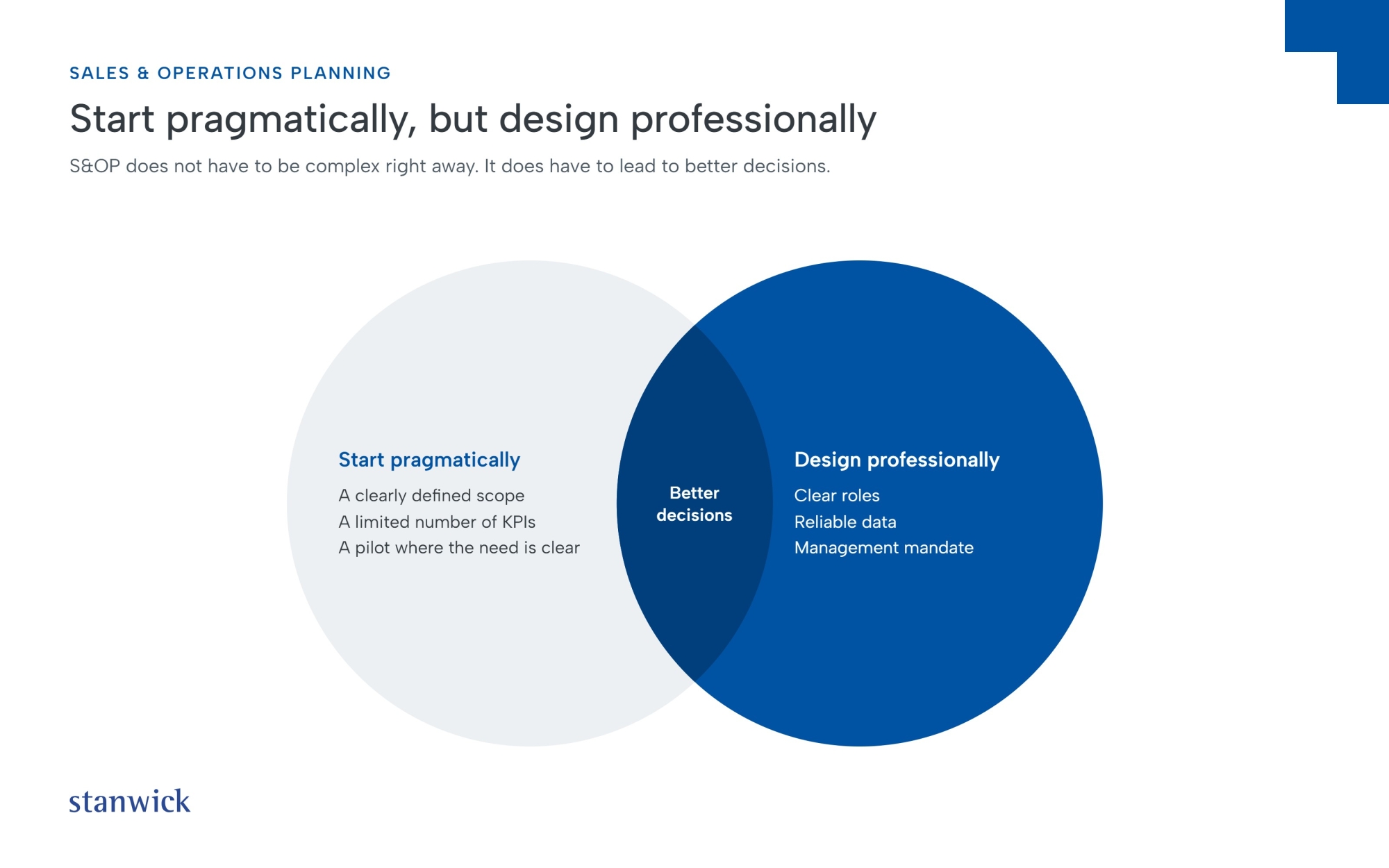
Stanwick’s vision: Start pragmatically, but design professionally
Start with a clearly defined scope and a limited number of KPIs, but ensure clear roles, reliable data and management commitment from day one. S&OP does not need to be complex straight away. It must, however, lead to better decisions.
Ready to guide your organisation towards better supply chain decisions?
Do you want not only to understand S&OP, but also to apply it successfully within your organisation?
Discover how mature your current decision-making process is and where demand, capacity, stock and financial impact are not yet sufficiently aligned.
Stanwick helps organisations move from siloed planning to integrated decision-making. We support companies with:
- Supply Chain Maturity Assessment
- S&OP and IBP implementation
- Supply Chain Decision Making training and coaching
Book a consultation about your Supply Chain Decision-Making journey or discover Stanwick Academy’s Supply Chain Decision-Making Masterclass.
Further background on our Supply Chain Excellence expertise.
Discover our range of supply chain excellence training courses.
Discover recent supply chain case studies.
Contact us so we can work on solutions together.

Stanwick. Drive for results
Stanwick offers result-oriented coaching programmes on operational excellence, project excellence and supply chain excellence with a focus on people, organisations and processes. We perform thorough assessments, develop clear roadmaps and implement and anchor improvements to guarantee sustainable results.
Our Stanwick Academy organises extensive training courses in which you learn together with a like-minded community about project management, continuous improvement, data-driven organisations, leadership and change management.