



Supply Chain Decision Making: from silos to integrated decision-making



What is Supply Chain Decision Making?
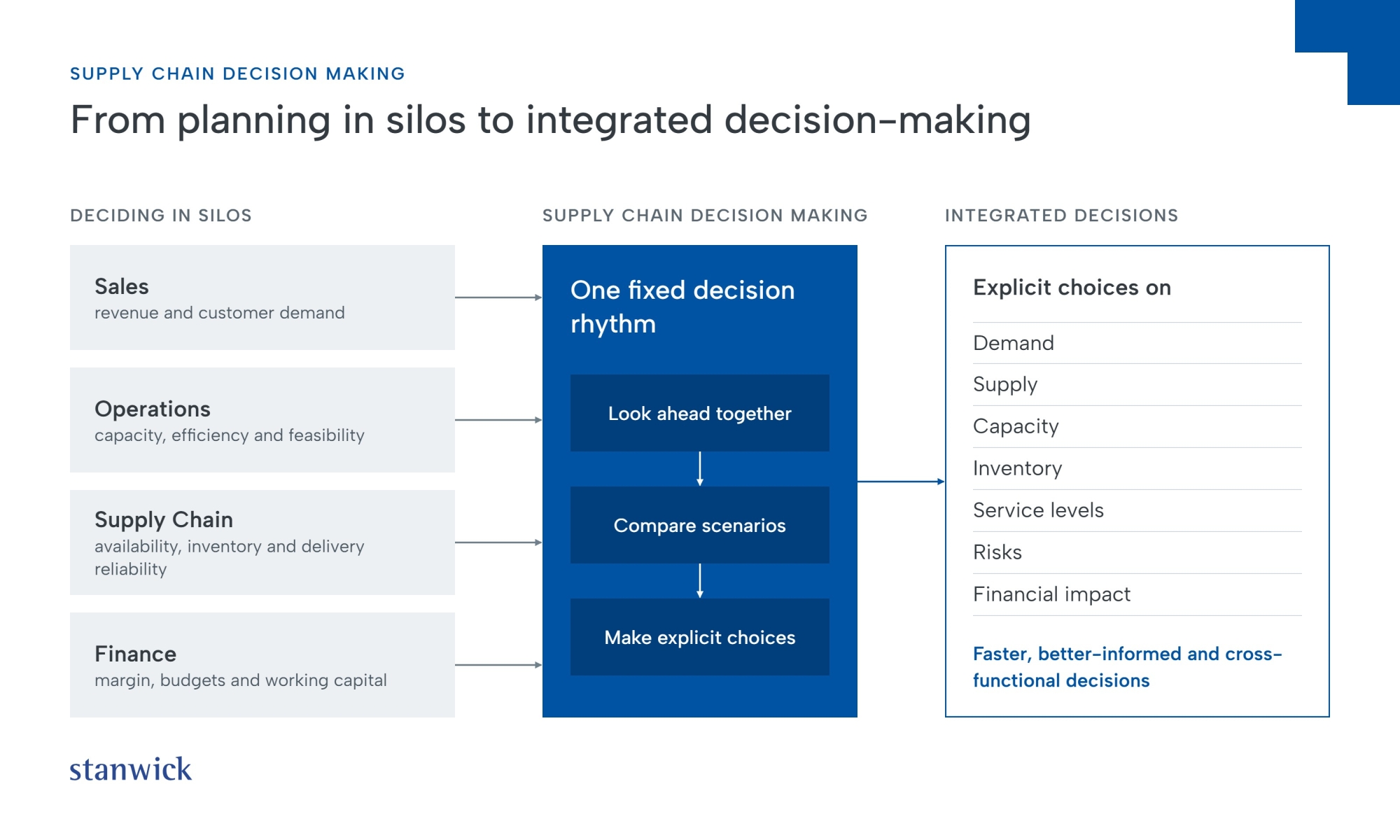
Supply Chain Decision Making is the structured process of making decisions regarding demand, capacity, stock, service, risk and financial impact. It brings together data, scenarios, KPIs and cross-functional collaboration, enabling organisations to make faster and better-informed choices. After all, strong supply chains are not created solely by better forecasts, more data or advanced planning tools. Above all, they are strengthened by better decisions.
Which decisions does supply chain decision-making link together?
A robust supply chain decision-making process makes the following questions visible, open to discussion and actionable:
- Which customer demand do we want to and are we able to meet?
- What capacity is available and where are the bottlenecks?
- Which stock is strategically necessary and which is surplus?
- Where do we accept risk and where do we build buffers?
- What impact do decisions have on service levels, margins and working capital?
- Which trade-offs need to be decided at management level?
“A good S&OP process does not simply produce more reports. It ensures that management teams make explicit choices more quickly regarding service levels, capacity, stock and financial impact.”
Jeroen Van den Hove – senior supply chain expert at Stanwick
Find out more about Supply Chain Decision Making
To help organisations move from siloed planning to integrated decision-making, Stanwick has developed a knowledge series covering Sales & Operations Planning, supply chain governance, KPI management, maturity assessment, SCOR (www.ascm.org) and S&OP Excellence.
We have divided the knowledge series into 2 clusters: we start with a basic understanding of S&OP, move on to an in-depth look at the governance model, and conclude with the continuous improvement of the supply chain decision-making process.
Cluster 1: S&OP Fundamentals: the basics of Sales & Operations Planning
In this cluster, we explain what S&OP is, why it remains relevant and how you can set it up in practice.
- What is Sales & Operations Planning? Definition, process and benefits of S&OP
A clear introduction to S&OP as an integrated management process that links demand, supply, capacity, stock and financial objectives. - Is S&OP still relevant in modern supply chains?
An insight into why traditional S&OP, as a reporting ritual, is outdated, but modern S&OP, as a decision-making process, is more relevant than ever. - How frequently do you organise an S&OP cycle?
A practical guide to the monthly S&OP cadence, the typical meeting structure and the difference between S&OP and S&OE.
Why this cluster is important
Many organisations use the term S&OP but mean something else: forecasting, production planning, stock review or sales meetings. This cluster creates a shared language and positions S&OP as one part of the supply chain decision-making process rather than merely a planning process.
Cluster 2: S&OP Advanced: Implementation and Continuous Improvement
A good S&OP process does not happen by itself. It requires clear roles, governance, data, KPIs, decision-making authority and a fixed rhythm. The articles in this cluster help organisations to translate S&OP into concrete action in line with these principles.
- 10 key elements for a successful S&OP process
An overview of the building blocks of strong S&OP: business case, executive sponsorship, reliable data, demand planning, supply planning, scenarios and continuous improvement. - How do you get started with S&OP in a medium-sized organisation?
A step-by-step implementation guide for organisations wishing to set up S&OP in a pragmatic yet professional manner. - Which KPIs should you use within an S&OP process?
An article on forecast accuracy, forecast bias, OTIF, service level, inventory turns, DIO, capacity utilisation, working capital and revenue attainment. - How do you measure the maturity of an S&OP process?
A maturity article that helps organisations assess their progress from reactive planning to integrated S&OP or Integrated Business Planning.
Do you want to improve your supply chain decision-making?
Discover how mature your current decision-making process is and where demand, capacity, stock and financial impact are not yet sufficiently aligned.
Stanwick helps organisations move from siloed planning to integrated decision-making. We support companies with:
- Supply Chain Maturity Assessments
- S&OP and IBP implementations
- Supply Chain Governance
- KPI development
- SCOR-inspired improvement programmes
- Executive Decision-Making frameworks
- S&OP Excellence programmes
- Training and coaching via Stanwick Academy
Book a consultation about your Supply Chain Decision-Making journey or discover Stanwick Academy’s Supply Chain Decision-Making Masterclass.
Further background on our Supply Chain Excellence expertise.
Discover our range of supply chain excellence training courses.
Discover recent supply chain case studies.
Contact us so we can work on solutions together.

Stanwick. Drive for results
Stanwick offers result-oriented coaching programmes on operational excellence, project excellence and supply chain excellence with a focus on people, organisations and processes. We perform thorough assessments, develop clear roadmaps and implement and anchor improvements to guarantee sustainable results.
Our Stanwick Academy organises extensive training courses in which you learn together with a like-minded community about project management, continuous improvement, data-driven organisations, leadership and change management.